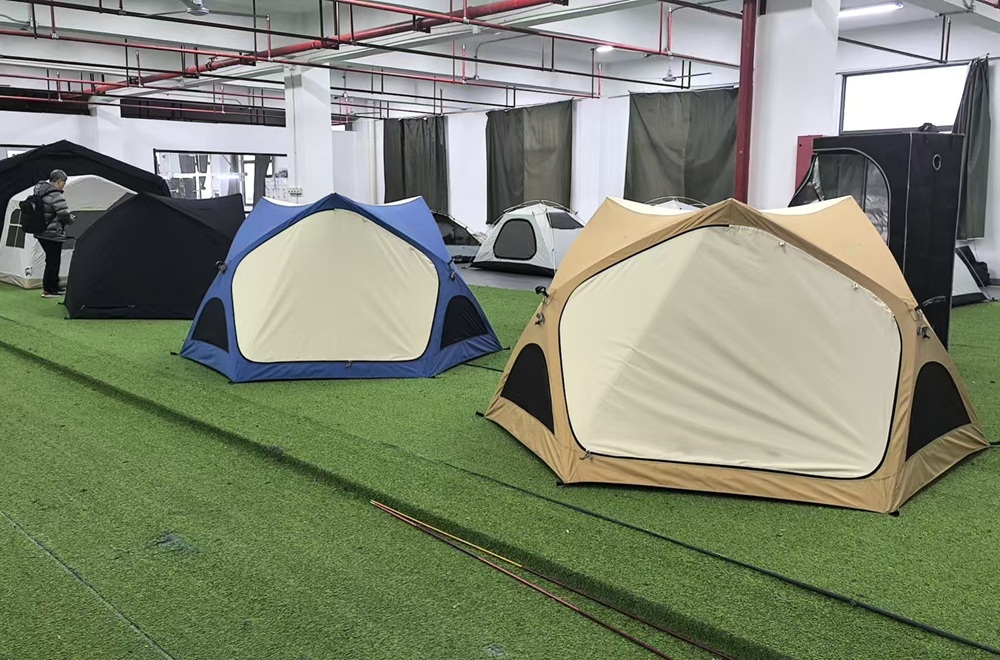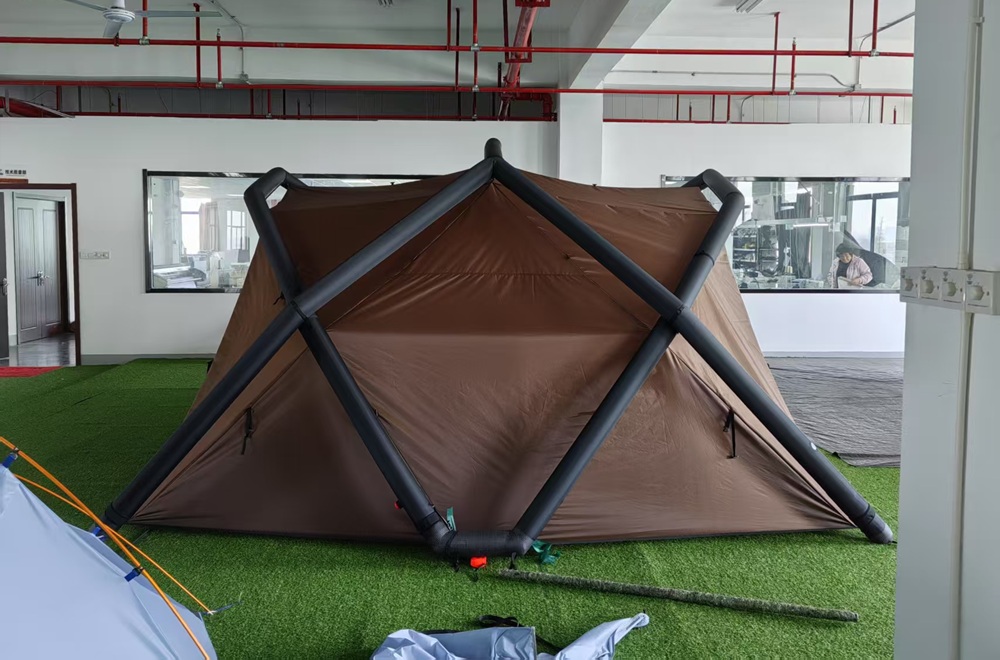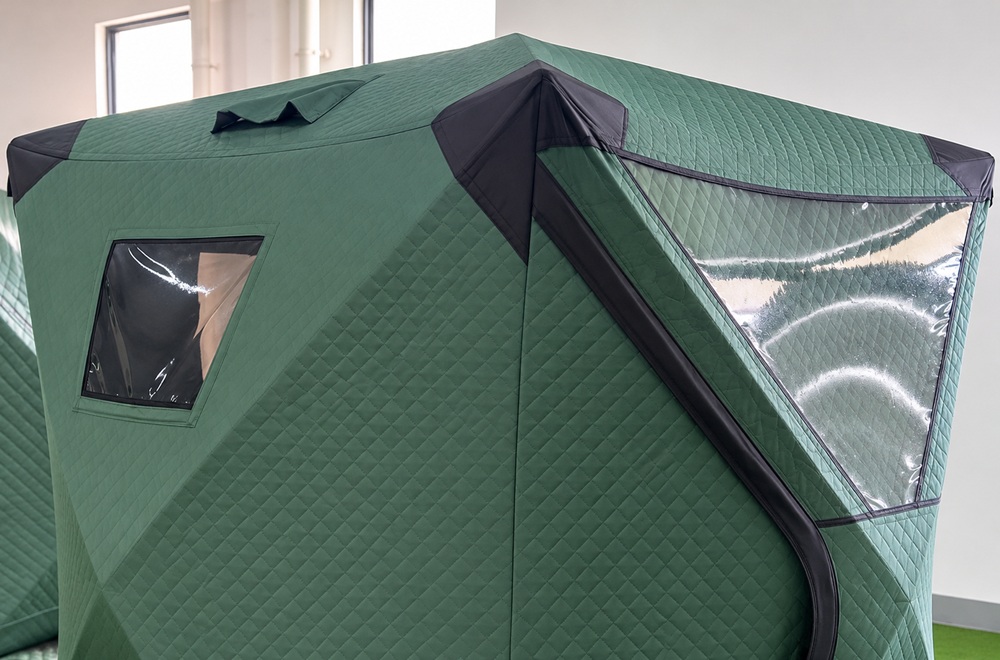
A large transparent window can give an outdoor sauna tent a wider view of its surroundings. For a brand developing a custom model, however, the window is more than a visual feature. Its size affects the surrounding fabric panels, the way the transparent film is joined to the tent body, and how the insulated wall is used.
Before approving a sample, OEM buyers should look at the window dimensions, material specification, joining method, frame compatibility, privacy cover, and intended operating conditions together.
At NastoCamp, our experience with TPU windows in insulated sauna tents has shown that these details are best resolved during product development, rather than after the sample construction has been approved.
Window Size and Position: Start With the Intended Function
The first question is what the transparent window needs to do.
A brand may want users to enjoy a view of the surrounding landscape while sitting inside the tent. Another may place greater importance on privacy or maintaining an enclosed sauna environment.
These expectations lead to different window arrangements.
In NastoCamp’s manufacturing experience, a common approach is to place a relatively large TPU window in the upper portion of the sauna tent wall, often around the upper third. A fabric cover can be closed when users want privacy or need the window covered as part of the insulation arrangement.
This is a practical design approach used in our work, not a standard dimension for all sauna tents.
As the transparent area becomes larger, the amount of surrounding fabric and the available connection boundaries may change. A design that works for a smaller window should not automatically be assumed suitable for a much larger opening.
Before discussing materials, buyers should establish the window’s intended position, viewing area, cover arrangement, and how the opening relates to the rest of the wall.
Selecting TPU and Other Transparent Window Materials
TPU, or thermoplastic polyurethane, is commonly used for transparent windows in NastoCamp’s sauna tent manufacturing.
It offers a combination of transparency and flexibility that can be useful when integrating a viewing area into a fabric shelter. However, TPU is a family of materials rather than one fixed specification.
Different grades and formulations can vary in flexibility, mechanical properties, weathering behavior, and resistance to discoloration. These characteristics need to be evaluated against the conditions expected for the finished product.
The same principle applies when comparing TPU with transparent PVC or other film materials. Neither material name, by itself, establishes suitability for a particular design.
For an OEM project, the material discussion should cover:
- The proposed film grade and nominal thickness.
- Transparency and acceptable appearance.
- Flexibility under the intended handling and operating conditions.
- Supplier information on aging, discoloration, and relevant environmental exposure.
- Compatibility with the planned joining process.
- Any project-specific material verification requirements.
Manufacturing behavior matters as well.
NastoCamp has encountered practical handling difficulties when cutting and sewing TPU film. Its surface can create feeding challenges during machine sewing, making the processing method an important consideration alongside the material’s finished appearance.
A film that looks suitable on a material swatch still needs to be assessed in the actual window construction.
Window Connections: Why the Surrounding Fabric Matters
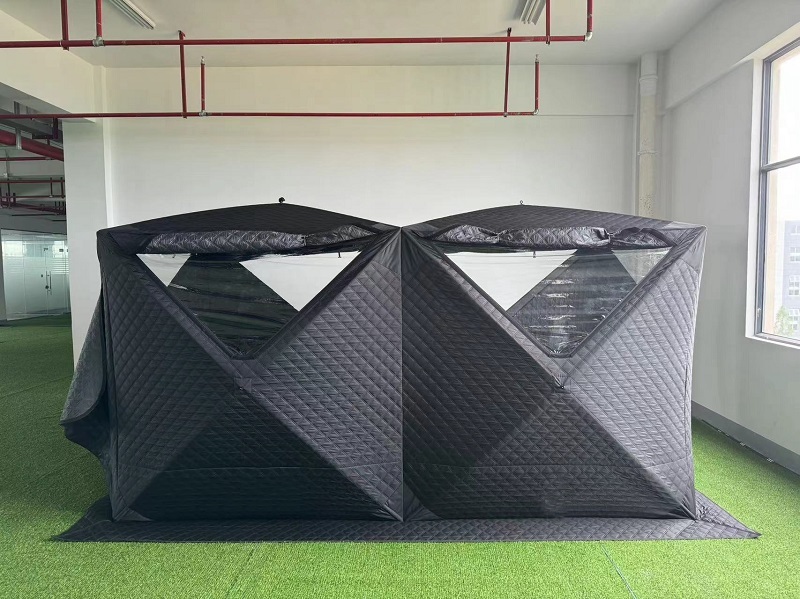
The way a transparent window joins the tent wall deserves particular attention.
NastoCamp commonly uses fabric transition sections when integrating TPU window film into surrounding tent panels.
One reason is the potential for tearing around needle holes in certain film constructions. Where a transparent film is stitched and placed under tension, the seam design needs to account for how the material behaves around those perforations.
This does not mean that TPU can never be sewn or that one joining method is appropriate for every TPU film.
Depending on the film grade and construction, joining options may include sewing, bonding, or suitable thermal welding processes. The selected method must be compatible with the materials and verified for the intended application.
What changes when the window becomes larger?
A larger transparent area can alter the relationship between the film, its surrounding seams, and the supporting tent structure.
For example, a window may look flat when the panel is laid on a worktable but behave differently once the tent is erected and its walls are tensioned.
The buyer and manufacturer therefore need to consider the complete assembly:
- Where the transparent film meets the surrounding fabric.
- How the connections are constructed.
- Whether the film remains properly positioned after setup.
- How the tent frame and panel tension affect the window.
- Whether the sample shows any visible stress or distortion around the connection areas.
These are design-review considerations, not evidence that a particular construction will necessarily fail.
Hub-style sauna tents need a complete-panel review
Many portable insulated sauna tents use hub-style structures for relatively quick deployment.
NastoCamp’s manufacturing team is cautious about using very large transparent areas in this type of construction. The concern is not only the film itself, but also how the transparent section and its connections behave within the erected wall.
Whether a particular design is suitable depends on the film specification, window dimensions, joining arrangement, supporting structure, and expected conditions.
For this reason, frame compatibility should be checked on a representative assembled sample rather than judged from a drawing or loose material panel alone.
Insulation and Privacy: The Role of a Window Cover
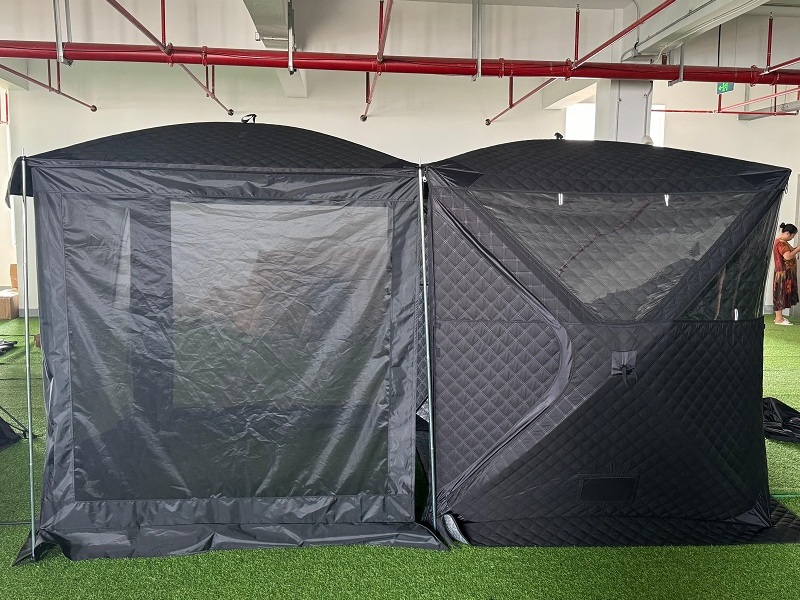
A transparent window and an insulated fabric wall are not necessarily equivalent in thermal performance.
In NastoCamp’s sauna tent designs, transparent windows are commonly paired with multilayer fabric covers. These covers allow users to close the viewing area for privacy and form part of the overall insulation arrangement.
Hook-and-loop fasteners are a common way to secure the cover in our manufacturing experience. Other closure arrangements may be considered depending on the design.
The cover needs to work as a usable part of the finished tent, not simply appear in the specification.
For example, buyers should review how much of the transparent area it covers, whether it stays secured, and how conveniently it can be opened or closed.
The relationship between the cover and the surrounding insulated wall also matters.
However, a multilayer cover should not be treated as proof of a specific insulation value. Condensation behavior and thermal performance depend on the actual construction and operating conditions, and any required performance claims need appropriate verification.
Heating Equipment Requires Separate Safety Assessment
Some outdoor sauna tents are designed for use with heating equipment, but stove compatibility cannot be established from the transparent window material alone.
Any proposed stove-equipped configuration requires a separate assessment of the complete product, including the heating equipment, ventilation, chimney arrangement, heat exposure, clearances, and applicable safety requirements. Combustion equipment can create serious fire and carbon monoxide hazards, particularly in enclosed shelters.
A transparent film specification, a stove-jack opening, or a completed tent sample should not be treated as evidence that the configuration is safe without appropriate product-specific verification.
What About a Full-Height Panoramic Window?
A request for a transparent area extending through most of a sauna tent’s sidewall is different from a conventional window placed in the upper portion of the wall.
It may leave less surrounding fabric, require a different joining arrangement, and create additional questions about the behavior of the complete wall when the tent is erected.
Before approving this type of design, the buyer should establish whether the proposed transparent area can be manufactured using the selected film and construction method.
The review should also address the connection boundaries, frame compatibility, privacy cover, insulation arrangement, and any safety requirements related to the intended use.
NastoCamp’s established manufacturing experience is primarily with more conventional TPU window configurations, rather than a verified full-height transparent sidewall construction.
A full-height panoramic request should therefore be treated as a project-specific development requirement. Its feasibility and performance need to be established through the actual design and sample evaluation.
Experience with a smaller window does not automatically validate a full-height version.
Sample Approval: What Should OEM Buyers Verify?
A representative sample gives the buyer an opportunity to assess how the transparent material, surrounding fabric, frame, and window cover work together.
In NastoCamp’s manufacturing practice, transparent-window inspection can include checking the film’s appearance, window dimensions and placement, joining areas, deployed appearance, and the operation of closures.
The following checklist combines these practical manufacturing observations with additional verification questions that buyers may need to agree on for a particular project. It is not a universal testing protocol or a claim that every NastoCamp order undergoes identical tests.
| Review Area | What the Buyer Should Confirm |
|---|---|
| Window dimensions and position | The transparent area matches the approved drawing and intended viewing requirements. |
| Material identification | The film corresponds to the agreed material specification. |
| Surface condition | Scratches, creases, haze, or other visible defects are assessed against agreed acceptance criteria. |
| Film-to-fabric connections | The joining arrangement and surrounding seams match the approved construction. |
| Erected appearance | The window sits as intended when the tent is fully assembled. |
| Hub and panel interaction | Setup does not reveal unacceptable interference, distortion, or visible connection concerns. |
| Window-cover operation | The cover opens, closes, and stays secured as intended. |
| Insulation arrangement | The cover and surrounding wall construction match the agreed sample design. |
| Project-specific verification | Any required environmental, mechanical, or safety evaluations are defined and completed as appropriate. |
| Production reference | Approved materials, dimensions, construction details, and acceptance requirements are documented. |
For a conventional window, the required checks may be relatively straightforward. A larger or less familiar construction may call for additional development work.
The important distinction is between inspecting whether a finished component matches the specification and establishing whether the specification itself is suitable.
Material selection and construction feasibility should be resolved during development, not left until incoming materials or finished goods are inspected.
A sample approval should also be understood in the context of what the sample actually demonstrates. Our article on what approving a tent sample actually confirms explains why a physical sample and documented performance requirements serve different purposes.
If the film, joining method, frame, or window dimensions change after approval, the affected parts of the design may need to be evaluated again before production proceeds.
Discuss the Window Construction Before Finalizing the Sample
A large transparent window should be developed as part of the complete sauna tent, rather than treated as an isolated viewing panel.
The film specification, surrounding connections, supporting frame, privacy cover, and insulation arrangement all influence what needs to be confirmed during sample development.
When discussing a custom sauna tent window with a manufacturer, provide the proposed opening dimensions, tent structure, window-cover requirements, and expected operating conditions. These details help identify the questions that need to be resolved before sample approval.
For related product configurations, explore NastoCamp’s ice fishing and sauna tent category or learn more about our custom tent development process.