Quick Answer: There is no single best material for every tent floor. The right choice depends on how the tent will be used, the ground conditions it may face, waterproofing and abrasion requirements, finished-weight targets, tent construction, manufacturing method, and cost. In NastoCamp’s OEM projects, PE and Oxford fabrics are common options for family and larger camping tents, while lighter nylon systems may be used when weight is a priority. Heavier PVC-based constructions can make more sense for certain inflatable and glamping tents. For OEM buyers, the important question is not simply which material has the highest specification, but which complete floor system fits the product being developed.
A tent floor may look like one of the simpler parts of a tent, but its material has to perform under very different conditions from the flysheet.
The flysheet primarily protects the interior from weather while contributing to the tent’s overall weight and packed size. The floor, by contrast, is placed directly against the ground. Depending on where the tent is used, it may be exposed to rough soil, grit, stones, twigs, repeated foot traffic, moisture, and concentrated loads from people and equipment.
That changes the material-selection priorities.
Waterproof performance matters, but so do abrasion resistance, tear strength, weight, construction, seam design, manufacturing compatibility, and cost.
This is also why asking whether PE, Oxford fabric, nylon, or PVC is “best” for a tent floor does not have a useful universal answer. A lightweight backpacking tent and a large family camping tent may require completely different floor systems even when both need reliable waterproof protection.
In NastoCamp’s OEM projects, experienced outdoor brands often already specify the floor construction they want. When a buyer has not finalized the specification, however, the manufacturer needs to look beyond the material name and understand the complete product: where the tent will be used, how much it should weigh, how the floor connects to the tent body, how it will be manufactured, and what commercial target the finished product needs to meet.
This guide explains that decision from an OEM tent manufacturing perspective.
Why Tent Floor Selection Is Different From Flysheet Selection
A flysheet and a tent floor can both be waterproof fabrics, but they do not experience the same mechanical demands.
Understanding that difference is the first step toward selecting an appropriate floor system.
Ground Contact Changes the Performance Priorities
Tent floors are exposed to conditions that a flysheet normally does not face.
When a tent is pitched, the floor may sit directly on soil, sand, gravel, small stones, roots, twigs, or other uneven surfaces. Movement inside the tent can repeatedly press and rub the fabric against those surfaces.
This is one reason tent footprints are commonly used to provide additional protection against abrasion and sharp objects underneath a tent floor.[1]
From a manufacturing perspective, this means that floor material selection cannot be based on waterproof rating alone.
In NastoCamp’s experience, three of the first performance considerations for a floor are typically:
- waterproof performance;
- abrasion resistance;
- tear strength.
But their relative importance changes with the product.
A large family camping tent, for example, is often transported by car. A moderate increase in floor weight may therefore be acceptable if it improves durability or helps the product meet its cost target.
An ultralight backpacking tent has a very different design objective. Saving several hundred grams across the complete tent may matter more than maximizing floor thickness. In that case, the development team may deliberately select a lighter floor and accept a different durability trade-off.
The goal is therefore not to maximize every specification.
It is to identify which properties matter most for the way the tent will actually be used.
Why the Floor May Use a Different Fabric From the Flysheet
The different performance priorities are visible in real commercial tent specifications.
For example, NEMO specifies its Kunai technical backpacking tent with a lighter 20D nylon ripstop fly and a heavier 30D nylon ripstop floor. The published waterproof specifications also differ between the two components.[2]
Larger tents can follow a very different material strategy. Big Agnes, for example, has used polyester Oxford floor constructions in larger camping tents, illustrating how floor specifications change as product size, weight priorities, and intended use change.[3]
These examples should not be interpreted as formulas that other brands need to copy.
Instead, they demonstrate a more important principle:
The flysheet and floor should be engineered for the jobs they actually need to perform.
NastoCamp sees the same principle in OEM development.
A lightweight tent may use relatively low-denier nylon because reducing finished weight is central to the product concept. A family tent may use PE or a heavier Oxford fabric because the commercial priorities are different.
This is also why statements such as “the floor should always be thicker than the flysheet” are too simplistic.
Often it is heavier or more abrasion-oriented, but the correct relationship depends on the complete product.
Start With the Tent Application, Not the Material Name
When a buyer asks which tent floor material to use, one of the first questions should be:
What kind of tent are you developing?
The same floor specification would make little sense across an ultralight trekking tent, an eight-person family tent, a heavy inflatable tent, and a semi-permanent glamping structure.
In NastoCamp’s OEM experience, representative floor options vary significantly across these applications.
Backpacking and Ultralight Tents
Weight and packed volume become much more important in backpacking products.
NastoCamp has worked with floor constructions including approximately 40D nylon as well as Oxford fabrics in this category. When the product is being engineered for more aggressive weight reduction, lower-denier nylon constructions such as 20D–40D may also be considered.
This does not mean thinner nylon is automatically a better floor material.
It means the product team is making a deliberate trade-off:
reduce weight while retaining enough waterproofing and durability for the intended use.
The rest of the tent must be engineered around the same objective.
Family Camping Tents
Family camping tents operate under different constraints.
Representative NastoCamp projects have used options such as:
- 120 gsm PE;
- 210D Oxford fabric.
These tents are often transported by vehicle rather than carried for long distances. As a result, adding some floor weight may be much less important than it would be in a backpacking product.
Durability, manufacturing practicality, waterproof performance, and target cost can therefore carry greater weight in the decision.
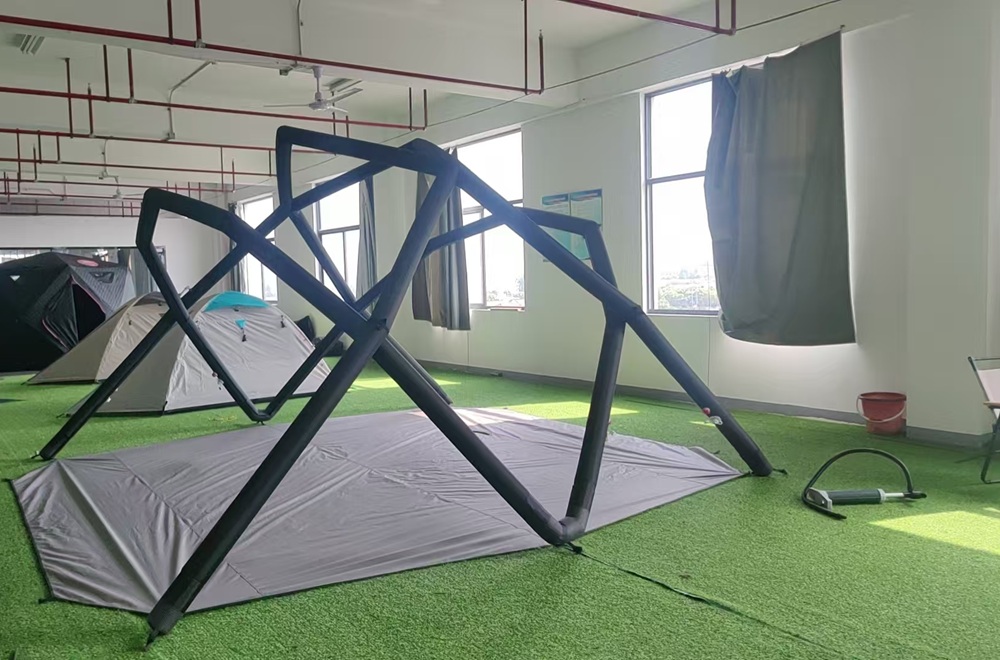
Inflatable and Cotton Tents
For heavier inflatable or cotton-based tent constructions, NastoCamp has worked with floor options such as:
- 500 gsm ripstop PVC;
- 210D Oxford fabric.
Again, the reason is not that PVC is inherently a “higher-quality” floor material than nylon or PE.
The entire product has a different engineering and commercial position.
A heavy inflatable tent that is transported by vehicle can tolerate a floor system that would be completely inappropriate for a lightweight trekking tent.
Glamping Tents
Weight is usually not the dominant design constraint for many glamping products.
NastoCamp has therefore used heavier-duty constructions such as ripstop PVC in this category.
For these products, priorities can shift toward durability, longer periods of installation, ground contact, cleaning requirements, and the way the floor integrates with the larger tent structure.
The body material and overall construction of the glamping tent also influence the final decision.
Humanitarian and Large Tents
For humanitarian and other large-structure tent projects, NastoCamp has worked with floor materials including:
- PE;
- 600D Oxford fabric.
These projects can have very different technical, procurement, durability, and cost requirements from recreational camping tents.
The specification should therefore be defined around the project rather than borrowed from another tent category.
Representative NastoCamp Project Examples
| Tent Application | Representative Floor Options | Typical Decision Priority |
|---|---|---|
| Backpacking / Ultralight | 40D nylon; lightweight Oxford; lower-denier nylon for aggressive weight targets | Weight + packability |
| Family Camping | 120 gsm PE; 210D Oxford | Durability + cost |
| Inflatable / Cotton Tent | 500 gsm ripstop PVC; 210D Oxford | Heavy-duty performance |
| Glamping | Ripstop PVC | Durability + construction |
| Humanitarian / Large Tent | PE; 600D Oxford | Durability + project cost |
These are representative materials from NastoCamp’s project experience, not universal specifications for every tent in each category.
The important takeaway is not the individual numbers in the table.
It is the selection logic behind them:
Start with the product application and performance priorities. Then select the floor material—not the other way around.
Waterproof Rating Is Important, but It Is Not the Whole Decision
Waterproof performance is one of the first specifications buyers consider when selecting a tent floor.
However, in OEM tent development, waterproof rating is only one part of the decision.
A higher hydrostatic-head number does not automatically mean a better floor system for every product. The appropriate waterproof requirement depends on the intended environment, expected usage, tent design, and overall product positioning.
For manufacturers and outdoor brands, the goal is not to maximize every specification.
The goal is to select a floor system that provides the required performance without creating unnecessary cost, weight, or manufacturing challenges.
What Waterproof Ratings Does NastoCamp Commonly See?
In NastoCamp’s OEM projects, tent floor waterproof requirements commonly fall within approximately the 2,000–5,000 mm range, with PU 5000 mm being one of the frequently used specifications.
For products exposed to more demanding weather conditions, buyers may request higher waterproof performance.
However, NastoCamp’s experience is that professional outdoor brands usually already understand their market requirements and provide their own technical specifications.
The manufacturer’s role is not always to replace the customer’s product knowledge.
Instead, it is to confirm whether the proposed specification is technically suitable and can be manufactured consistently.
A professional buyer may already know:
- where the tent will be sold;
- what weather conditions it must handle;
- what standards their market requires;
- how the product will be positioned.
Therefore, the final specification should be a result of cooperation between the brand and the manufacturer.
Why Higher Waterproof Ratings Are Not Always Better
It is easy to assume:
A higher waterproof rating always means a better tent floor.
In practice, the relationship is more complicated.
Increasing waterproof performance may affect:
- material selection;
- coating type;
- fabric weight;
- cost;
- handling characteristics;
- manufacturing process.
For example, a lightweight backpacking tent may prioritize low weight and packability, while a large family tent may accept additional material weight because durability and cost efficiency are more important.
A higher specification that does not match the product’s actual needs can create unnecessary cost without improving the user experience.
The better question is:
What waterproof performance does this specific tent actually require?
Waterproof Fabric Alone Does Not Create a Waterproof Floor
One of the most important points for OEM buyers is that waterproof performance does not depend only on the fabric specification.
A tent floor is a finished assembly.
Its waterproof performance can also be affected by:
- seam construction;
- seam taping quality;
- corners;
- connection points;
- joining methods;
- zipper and accessory areas.
A floor fabric with a high waterproof rating can still fail if water enters through poorly executed seams or connection areas.
This is why experienced manufacturers evaluate the complete tent system rather than only checking the fabric specification.
NastoCamp Manufacturing Perspective
In actual production, when a floor-related leakage issue appears, the investigation does not stop at:
“Is the floor fabric waterproof enough?”
The team also checks:
- where the water entered;
- whether seams were properly sealed;
- whether connected components created another leakage path;
- whether the construction method matched the material.
This system-level approach is essential for reliable outdoor products.
Material Choice Also Determines the Manufacturing Method
Many buyers think of tent floor selection as a material decision only.
However, in OEM manufacturing, the material choice also influences:
- how the floor is cut;
- how components are joined;
- which sealing method is required;
- production speed;
- operator requirements;
- quality-control procedures.
A floor material that looks excellent on a specification sheet may create completely different manufacturing challenges compared with another material.
Coated Nylon and Polyester Require Careful Handling
Lightweight coated fabrics can provide excellent performance for specific applications, but they may also require more careful manufacturing control.
For example, NastoCamp has experience with lightweight silicone-coated nylon constructions where the fabric surface can be more difficult to handle during production.
Potential challenges include:
- smoother/slipperier fabric behavior;
- more difficult sewing control;
- slower production speed;
- adjustments to presser-foot settings;
- different needle selection.
These factors do not mean lightweight technical fabrics are unsuitable.
Instead, they mean:
Advanced materials often require more specialized manufacturing knowledge.
A factory that can produce a sample successfully still needs the process capability to maintain consistency during mass production.
PVC Ripstop Floors May Require Welding Instead of Traditional Sewing
Heavy PVC-based floor systems can follow a different manufacturing approach.
For certain PVC ripstop constructions, welding or heat sealing may be used instead of relying only on traditional sewing.
This changes the production requirements.
Important factors may include:
- welding temperature;
- pressure;
- machine settings;
- production speed;
- bonding strength.[4]
In NastoCamp’s experience, incorrect welding parameters can result in incomplete bonding between materials.
Potential consequences include:
- weak connections;
- splitting during use;
- separation between layers.
Therefore, before mass production, the welding parameters need to be adjusted and verified through testing.
Material and Construction Must Be Designed Together
A common mistake in OEM development is selecting the material first and considering construction later.
In reality, the floor material and the tent structure must work together.
For example:
- sewn-in groundsheets;
- detachable floors;
- bathtub-style floors;
- large integrated floor systems;
may require different connection and sealing approaches.
Materials such as PE or PVC may not always follow exactly the same joining process as PU-coated nylon or polyester fabrics.
The manufacturer needs to consider:
- how the floor connects to the tent body;
- how waterproofing is maintained at the connection;
- whether the selected process is suitable for the material.
The correct question is not only:
“Is this material waterproof?”
It is:
“Can this material be successfully integrated into the final tent structure?”
Common Tent Floor Quality Problems OEM Buyers Should Understand
A tent floor specification can look perfect on paper:
- correct fabric;
- required waterproof rating;
- suitable material weight;
- approved sample.
However, finished-product quality depends on much more than the material specification.
During OEM production, floor-related problems are often caused by the interaction between:
- material characteristics;
- construction method;
- sewing quality;
- sealing process;
- storage conditions;
- component compatibility;
- production control.
Understanding these potential issues helps buyers evaluate suppliers more effectively and ask better technical questions before mass production.
Seam Leakage: The Fabric May Not Be the Real Problem
When buyers discover water inside a tent, the first assumption is often:
“The floor material is not waterproof enough.”
In reality, the material itself is not always the root cause.
A tent floor is a complete waterproof system. Even if the fabric has a suitable waterproof rating, leakage can still occur through:
- seams;
- corners;
- floor-to-wall connections;
- stitched areas;
- poorly sealed sections.
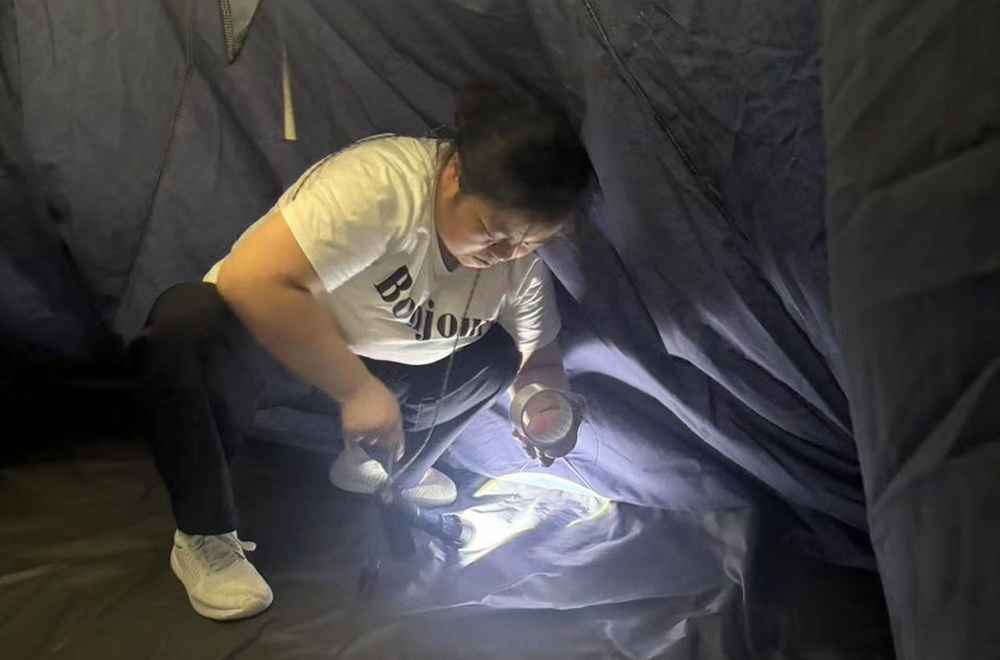
In NastoCamp’s production experience, seam areas are among the first places checked when investigating floor-related leakage.
The inspection focuses on:
- whether seam tape fully covers the stitched area;
- whether the sealing process is stable;
- whether corners and stress points are properly handled;
- whether the construction method matches the material.
This leads to an important principle:
A waterproof floor fabric does not automatically create a waterproof tent floor.
The final performance depends on the complete manufacturing process.
PU Coating Stickiness and Long-Term Storage Problems
Polyurethane (PU) coatings are widely used in outdoor fabrics because they provide waterproof protection and can be applied to many different textile constructions.
However, coating quality and long-term storage conditions can influence the final product performance.
NastoCamp has encountered situations where lower-quality PU-coated materials may develop:
- sticky surfaces;
- adhesive-like feeling;
- coating degradation;
especially after long storage periods or under high-temperature conditions.
For OEM buyers, this creates an important lesson:
The waterproof number on a specification sheet does not fully describe long-term material performance.
When selecting coated fabrics, manufacturers need to consider not only:
- initial waterproof rating;
- fabric weight;
- material type;
but also:
- coating quality;
- supplier consistency;
- storage conditions;
- aging behavior.
External outdoor equipment companies also recognize that aging polyurethane coatings can become sticky, peel, or deteriorate over time, which is why coating condition is an important consideration for long-term tent maintenance and performance.[5]
Color Migration: A Hidden Risk With Dark Floor Fabrics
Color migration is a quality issue that many buyers may not consider when developing a tent.
The problem is not always related to waterproof performance.
In some material combinations, dark-colored coated fabrics—especially black PU-coated Oxford fabrics—may transfer color onto lighter-colored tent body fabrics during storage or contact.
This can create unexpected appearance problems even when:
- the waterproof specification is correct;
- the fabric strength is acceptable;
- the tent passes normal functional checks.
Based on NastoCamp’s production experience, this is a risk that should be considered when combining:
- dark floor fabrics;
- light-colored tent bodies;
- long-term folded storage conditions.
One practical prevention method used by NastoCamp is a simple material compatibility check:
Two related fabrics are pressed together and stored for approximately one week to observe whether any color transfer occurs.
This type of check is not usually visible from a material specification sheet, but it can prevent quality issues before mass production.
NastoCamp Manufacturing Experience
This is an example of why OEM quality control cannot rely only on:
- supplier datasheets;
- material names;
- waterproof ratings.
Some product risks only become visible when materials interact with each other in the actual finished-product environment.
Sewing Quality and Sealing Compatibility
Even when the correct floor material is selected, poor execution during manufacturing can reduce the final product quality.
Potential issues include:
- uneven stitching;
- insufficient reinforcement;
- poor seam alignment;
- unsuitable sealing methods;
- mismatch between material characteristics and production process.
Different materials also require different handling.
For example:
- lightweight technical fabrics may require more careful sewing control;
- PVC systems may depend more heavily on welding parameters;
- coated fabrics may require specific sealing considerations.
A capable OEM manufacturer should understand not only:
“Can this material be used?”
but also:
“Can this material be processed consistently at production scale?”
This distinction separates a factory that can produce one acceptable sample from a factory that can maintain quality across thousands of units.
A Real NastoCamp Leakage Investigation: The Floor Was Not the Root Cause
One of the biggest misconceptions in tent waterproofing is assuming that the place where water appears is always the place where the failure begins.
For example, if water is found near the tent floor, many buyers may immediately suspect:
- insufficient floor waterproof rating;
- poor groundsheet material;
- damaged floor fabric.
However, waterproof performance is a system.
Water can enter through many different paths, and identifying the actual failure point requires investigation rather than assumptions.
A real NastoCamp project illustrates this point.
The Initial Problem: Inconsistent Rain Test Results
The project involved a large inflatable tunnel tent.
During rain testing, the team noticed an unusual issue:
- sometimes the tent passed the rain test;
- sometimes water appeared inside.
This inconsistency suggested that the problem was unlikely to be simply:
“The floor material is not waterproof enough.”
If the floor fabric itself was the main problem, the failure would usually be more consistent.
Therefore, the team continued investigating the complete tent structure.
Investigation: The Water Entry Point Was Not the Floor Fabric
After further testing, NastoCamp identified that the water was entering through the zipper area.
During long-duration rain exposure:
- the zipper tape absorbed water;
- moisture gradually moved through the zipper area;
- water entered the tent interior.
The floor was not the original failure point.
This was an important finding because the visible symptom could easily have led the team in the wrong direction.
A buyer seeing water near the bottom of the tent might assume:
“The floor waterproofing failed.”
But the actual issue was related to another component.
Solution: Improving the Zipper System
To solve the problem, NastoCamp changed the zipper solution by using a:
water-repellent zipper
After the improvement, the leakage issue was resolved.
The lesson from this project was not only about zippers.
It demonstrated a broader principle:
A tent is a complete waterproof system. Individual materials cannot be evaluated separately from the surrounding construction and components.
What OEM Buyers Can Learn From This Case
When evaluating tent suppliers, buyers should be careful about asking only:
- What waterproof rating is the floor?
- What material is the floor made from?
- Is the fabric PU-coated?
Those questions are important, but they do not tell the complete story.
A reliable OEM partner should also understand:
- how different components interact;
- where water can travel;
- how seams and connections behave over time;
- how to identify root causes during testing.
The ability to investigate problems is often more valuable than simply passing a single laboratory specification.
NastoCamp Manufacturing Perspective
In outdoor product development, testing is not only a final approval step.
It is also a learning process.
When a product does not perform as expected, experienced manufacturers use the results to identify:
- the actual failure mechanism;
- whether the issue comes from material selection;
- whether the construction needs adjustment;
- whether another component affects the final performance.
This is why OEM buyers should evaluate not only a supplier’s product specifications, but also their engineering and problem-solving capability.
Cost Engineering: When a Different Floor Material Makes Better Commercial Sense
In OEM tent development, material selection is not only a technical decision.
It is also a commercial decision.
A common situation in product development is that a buyer has a target retail position or purchase price, but the initial specification creates a cost that does not fit the market.
At this stage, a professional OEM manufacturer should not simply reduce quality without explanation.
Instead, the goal should be:
Identify which specifications are essential for the product’s purpose, and which areas can be adjusted while maintaining the required performance.
This process is often called cost engineering.
Cost Engineering Is Not the Same as Making a Cheaper Tent
For inexperienced buyers, reducing cost may sound simple:
“Use cheaper materials.”
However, this approach can create unexpected problems.
A responsible cost-engineering process considers:
- intended application;
- expected user experience;
- durability requirements;
- manufacturing feasibility;
- market positioning;
- long-term product reputation.
The question is not:
“How can we make this product as cheap as possible?”
The better question is:
“How can we achieve the required product performance at a commercially realistic cost?”
A tent developed for occasional family camping does not necessarily require the same material strategy as an expedition product.
Similarly, a professional outdoor brand may accept a higher specification because the product positioning justifies the additional cost.
The correct specification depends on the product.
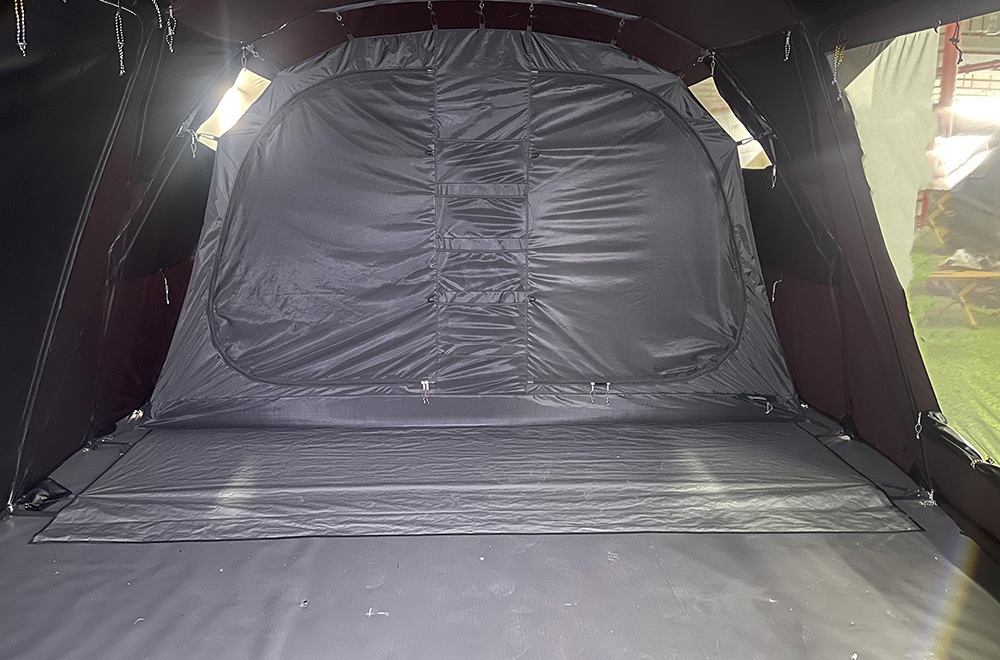
NastoCamp Example: Replacing Oxford Floor With PE to Meet the Target Cost
NastoCamp has experienced projects where the original floor requirement created a cost challenge.
In one case:
Initial requirement:
- Oxford fabric floor
Challenge:
- The resulting cost was higher than the customer’s target price.
Instead of simply reducing quality elsewhere, NastoCamp evaluated alternative solutions.
The recommendation was:
Replace the Oxford floor with a suitable PE floor construction.
The purpose was not to create a lower-quality tent.
The goal was to identify a different floor solution that could still satisfy the product’s actual requirements while improving cost efficiency.
The result:
- the target cost was achieved;
- the project moved forward successfully;
- the customer placed the order.
Why Material Changes Must Be Evaluated by Performance, Not Price Alone
A common misunderstanding is:
More expensive material always means a better product.
In reality, the better question is:
Does the material provide the performance required for this specific application?
For example:
A family camping tent mainly used at established campsites may have different priorities from a lightweight backpacking tent carried over long distances.
A heavier or more expensive floor may not always provide meaningful additional value for the intended user.
Likewise, choosing the cheapest possible material without considering:
- abrasion;
- waterproofing;
- durability;
- manufacturing process;
can create quality problems later.
A professional manufacturer helps balance: Performance Requirement, Product Positioning, Manufacturing Reality and Target Cost.
Where Cost Reduction Can Be Reasonable, and Where It Becomes Risky
Not every cost adjustment has the same impact.
Some adjustments may be reasonable when they match the product positioning:
- selecting a different suitable floor material;
- optimizing unnecessary specifications;
- improving material utilization;
- adjusting packaging;
- redesigning non-critical components.
However, reducing cost by ignoring critical quality factors can create long-term problems:
- insufficient durability;
- unstable production quality;
- increased returns;
- customer complaints;
- brand damage.
For outdoor brands, the cheapest initial purchase price is not always the lowest total cost.
A poorly engineered tent can create much higher costs through:
- warranty issues;
- replacements;
- negative reviews;
- lost market trust.
Why OEM Buyers Should Discuss the Reason Behind a Specification
A specification is most useful when the manufacturer understands why it exists.
For example:
A buyer may request:
“I need a 5000 mm waterproof floor.”
A good OEM discussion should continue:
- Where will the tent be used?
- Who is the target customer?
- How frequently will it be used?
- Is weight important?
- Is the tent positioned as premium, mid-range, or budget?
- Is the product expected to last for occasional or regular use?
Understanding the reason behind a specification allows the manufacturer to provide better recommendations.
The final goal is not simply to match a number.
It is to develop the right product.
NastoCamp Manufacturing Perspective
NastoCamp generally does not focus on producing the lowest-priced tents in the market.
The company’s approach is to help customers develop products with:
- appropriate materials;
- reliable manufacturing processes;
- stable quality;
- realistic commercial positioning.
For OEM buyers, a good supplier should not only answer:
“Can you make this specification?”
They should also be able to discuss:
“Is this specification the right choice for the product you are trying to build?”
Custom Floor Specifications Can Affect MOQ
When developing a custom tent, buyers often focus on the product-level specifications:
- tent size;
- fabric;
- color;
- pole structure;
- accessories;
- packaging.
However, some smaller components can still have a significant impact on the project’s minimum order quantity (MOQ).
Tent floors are a good example.
Although the floor represents only one part of the complete tent, customizing the floor material or color may involve upstream material suppliers, coating processes, and production requirements that are independent from the actual amount of fabric used in each tent.
Why a Small Component Can Create a Large MOQ Challenge
From a buyer’s perspective, a floor may appear to be a relatively small area compared with the entire tent.
Therefore, it is natural to ask:
“Why can’t the factory simply produce a small quantity of custom floor fabric?”
The reason is that textile production does not always operate at the same scale as final tent assembly.
Upstream suppliers may have their own requirements related to:
- fabric production batches;
- dyeing minimums;
- coating runs;
- special material preparation;
- customized specifications.
This means a customer request for a special floor material may create additional supply-chain requirements even if the actual floor consumption per tent is limited.
Common Floor Customization Requests That May Increase Complexity
Examples include:
- unusual floor colors;
- custom-dyed materials;
- special fabric constructions;
- non-standard waterproof specifications;
- special coating requirements.
For a large-volume outdoor brand, these requirements may be reasonable because the order quantity can support customized production.
For a smaller or new brand developing an initial product, however, customization needs to be evaluated carefully.
A technically possible request may still create:
- higher MOQ;
- longer lead time;
- higher material cost;
- more complicated inventory management.
Why Black and Gray Floors Are Common Choices
In commercial tent production, black and gray floor colors are widely used.
This is not only a design preference.
Standard colors often provide practical advantages:
- easier material sourcing;
- better supply availability;
- lower customization requirements;
- simpler production planning.
NastoCamp’s experience is that many customers do not request special floor colors because the floor is primarily a functional component rather than a visible design element.
For many products, investing customization resources in areas that customers see more directly—such as:
- tent body color;
- logo;
- printing;
- packaging;
may provide greater market value.
When Custom Floor Specifications Make Sense
Customizing the floor can still be valuable when it supports a clear product strategy.
Examples include:
- a premium outdoor brand requiring a specific material system;
- a specialized market with unusual environmental requirements;
- a product where floor performance is a key selling point;
- a large-volume program that justifies customized material production.
The key is to evaluate customization from a complete product perspective:
Does this customization create meaningful value for the final product and customer?
If yes, the additional complexity may be justified.
If not, a standard proven material may provide a better balance between performance, cost, and production efficiency.
NastoCamp Manufacturing Perspective
In OEM development, the best specification is not always the most customized specification.
A practical product strategy considers:
- performance requirements;
- market positioning;
- production feasibility;
- supplier capability;
- MOQ impact;
- total project cost.
A good manufacturer helps buyers understand these trade-offs before finalizing the specification.
How Should OEM Buyers Choose a Tent Floor System?
Choosing a tent floor is often treated as a material-selection question:
“Should we use PE, Oxford, nylon, or PVC?”
However, a more effective OEM development approach is to evaluate the complete floor system.
The right decision should consider:
- where the tent will be used;
- what performance the user actually needs;
- how the floor will be integrated into the tent;
- how the factory will manufacture it;
- what cost target the product must achieve.
Based on NastoCamp’s OEM experience, buyers can use the following framework when discussing floor specifications with a manufacturer.
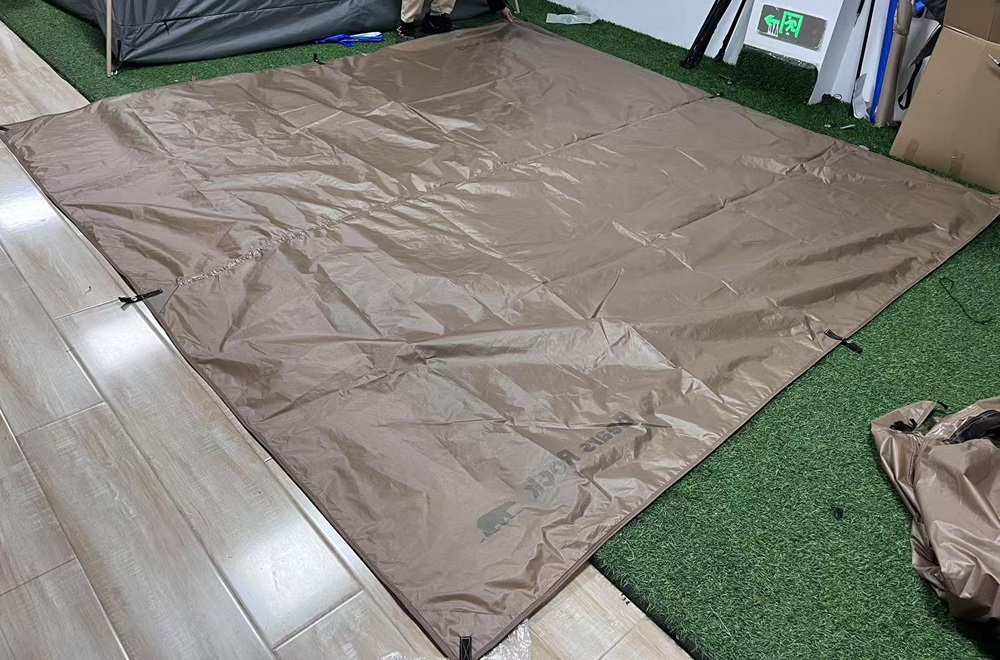
Step 1: Define the Tent Application First
The first question should not be:
“Which floor material is strongest?”
It should be:
“What type of tent are we developing?”
Different applications create different priorities.
For example:
| Application | Typical Priority |
|---|---|
| Backpacking / Ultralight | Low weight, packability |
| Family Camping | Durability, cost balance, easy production |
| Inflatable Tent | Heavy-duty performance, structural compatibility |
| Glamping Tent | Long-term durability, comfort, larger-scale use |
| Humanitarian / Large Tent | Durability, reliability, procurement efficiency |
A floor specification suitable for an ultralight backpacking tent may not be appropriate for a large family tent.
The application defines the engineering direction.
Step 2: Understand the Ground Conditions
After defining the application, the next consideration is:
“What kind of ground will this tent face?”
Important questions include:
- Will it be used on soft grass?
- Will it be exposed to gravel or rocky terrain?
- Will users frequently move equipment inside?
- Is the tent expected to remain installed for extended periods?
Ground exposure directly affects the importance of:
- abrasion resistance;
- tear strength;
- puncture resistance.
A campsite tent used occasionally may have different requirements from a product designed for repeated commercial use.
Step 3: Prioritize the Required Performance
A common mistake is trying to maximize every specification.
A better approach is to rank the requirements.
For tent floors, the main performance factors usually include:
Waterproof Performance
The floor needs sufficient protection for the intended environment.
However:
Higher waterproof numbers do not automatically create a better product.
The specification should match the real usage conditions.
Abrasion Resistance
Because the floor contacts the ground directly, abrasion resistance is often a critical consideration.
This is especially important for:
- family tents;
- large tents;
- heavy-use products.
Tear Strength
A floor may experience concentrated stress from:
- uneven ground;
- equipment;
- repeated folding;
- installation.
The material should provide appropriate mechanical strength for the application.
Step 4: Decide How Important Weight Is
Weight is one of the biggest factors separating different tent categories.
For backpacking and ultralight products:
- lower weight;
- smaller packed volume;
- easier carrying;
may justify using lighter floor materials.
For family camping or larger tents:
- durability;
- cost;
- long-term use;
may become more important than saving several hundred grams.
Therefore:
The lightest floor is not always the best floor.
The best choice depends on the product’s market position.
Step 5: Confirm the Tent Construction
The floor material cannot be evaluated separately from the tent structure.
Before finalizing the specification, buyers should consider:
- sewn-in floor;
- detachable floor;
- bathtub floor;
- inflatable tent floor;
- large integrated structures.
Different constructions may require different:
- joining methods;
- seam treatments;
- reinforcement strategies;
- waterproofing solutions.
A material that performs well by itself may still require redesign if it does not integrate correctly into the final structure.
Step 6: Confirm Manufacturing Compatibility
This is the step that many inexperienced buyers overlook.
The question is not only:
“Can this material achieve the required performance?”
It is also:
“Can this material be manufactured consistently at production scale?”
Manufacturing considerations may include:
- sewing difficulty;
- seam sealing;
- welding requirements;
- operator experience;
- equipment capability;
- quality-control methods.
For example:
- lightweight technical fabrics may require more careful sewing control;
- PVC systems may require welding parameter control;
- different coatings may affect sealing methods.
The manufacturing process is part of the product specification.
Step 7: Balance Performance With Target Cost
Every commercial product has a market position.
A premium expedition tent, a family camping tent, and a promotional event tent should not necessarily use the same floor specification.
When the original specification exceeds the commercial target, manufacturers can evaluate alternatives through cost engineering.
Possible adjustments may include:
- selecting another suitable material;
- changing non-critical specifications;
- optimizing construction;
- improving material efficiency.
The goal should not be:
“Make the product as cheap as possible.”
The goal should be:
“Achieve the required product performance at the right commercial cost.”
Step 8: Validate the Final System Through Testing
The final step is validation.
A reliable floor system should be checked through appropriate quality-control procedures.
Depending on the product, this may include:
- material inspection;
- waterproof testing;
- seam inspection;
- sealing inspection;
- bonding strength checks;
- color migration checks;
- finished-tent rain testing.
Testing is not only about confirming that a product passes.
It is also about discovering potential problems before mass production.
NastoCamp Tent Floor Selection Checklist
For OEM buyers, the following questions can help create a more complete specification:
| Question | Why It Matters |
|---|---|
| What type of tent is being developed? | Defines the design priorities |
| Where will the tent be used? | Determines environmental requirements |
| How important is weight? | Balances durability and portability |
| What waterproof level is actually required? | Avoids unnecessary over-specification |
| What ground conditions are expected? | Determines abrasion and tear requirements |
| How will the floor connect to the tent? | Influences construction method |
| Can the factory manufacture the selected material consistently? | Ensures production reliability |
| Does the specification fit the target price? | Ensures commercial feasibility |
| Are testing requirements defined? | Reduces production risk |
The Key Principle: Select the System, Not Just the Material
The most important lesson for OEM buyers is:
A tent floor should not be selected by material name alone. It should be selected as a complete system that combines material, construction, manufacturing process, testing, and commercial requirements.
PE, Oxford, nylon, and PVC can all be suitable choices in the right application.
The challenge is not finding the “best” material.
The challenge is finding the right material for the right product.
What We Evaluate Before Recommending a Tent Floor Material
For OEM buyers, selecting a tent floor is not simply about choosing a fabric from a supplier catalog.
Before recommending a floor solution, a manufacturer needs to understand how the product will be used and how the complete tent will be developed.
At NastoCamp, floor selection is evaluated as part of the entire tent-development process.
The objective is not to recommend the most expensive material.
It is to recommend a floor system that provides the right balance of:
- performance;
- durability;
- manufacturing feasibility;
- cost;
- long-term product reliability.
Product Application and Market Position
The first consideration is always the product itself.
Before discussing materials, NastoCamp evaluates:
- What type of tent is being developed?
- Who is the target user?
- How will the tent be used?
- Is it positioned as lightweight, family-oriented, premium, commercial, or heavy-duty?
A floor material suitable for a backpacking tent may not be suitable for a large family tent.
Likewise, a heavy-duty material designed for long-term outdoor use may be unnecessary for a lightweight recreational product.
The product positioning determines the engineering priorities.
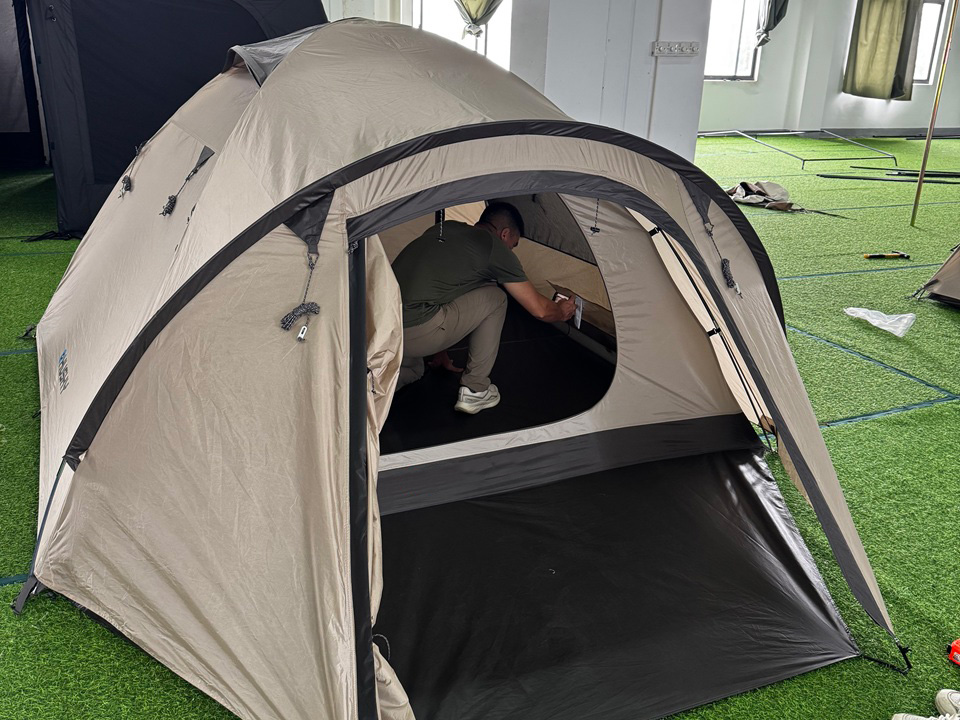
Required Performance Based on Real Usage
After understanding the product application, the next step is identifying the actual performance requirements.
NastoCamp considers:
Waterproof Requirement
The floor must provide sufficient protection for the expected environment.
However, the target should come from:
- climate;
- market requirements;
- user expectations;
- product positioning.
Not every product requires the highest possible waterproof specification.
Abrasion and Tear Resistance
Because the floor directly contacts the ground, NastoCamp pays particular attention to:
- expected ground conditions;
- product usage frequency;
- tent size;
- user behavior.
A family camping tent and an ultralight backpacking tent may require completely different durability strategies.
Weight Requirement
Weight is especially important for:
- backpacking tents;
- trekking tents;
- lightweight outdoor products.
For larger tents, however, durability and cost may become higher priorities.
The final material choice is therefore always a balance.
Construction Method and Material Compatibility
A floor material cannot be evaluated separately from how it will be integrated into the tent.
NastoCamp considers:
- how the floor connects with the tent body;
- whether the structure requires sewing;
- whether sealing or welding is needed;
- whether reinforcement is required at stress points.
Different materials create different production requirements.
For example:
- lightweight coated nylon may require more careful sewing control;
- PVC-based systems may require welding parameter control;
- different coatings may affect seam-sealing methods.
A material that performs well in isolation still needs to be compatible with the actual construction process.
Production Stability and Quality Control
A sample that looks good is only the beginning of OEM development.
Before mass production, manufacturers need to consider whether the selected floor system can be produced consistently.
Important factors include:
- material consistency;
- production process stability;
- worker experience;
- equipment capability;
- inspection requirements.
For floor systems, NastoCamp pays particular attention to:
- seam quality;
- sealing quality;
- bonding areas where applicable;
- material compatibility;
- potential color migration issues.
The goal is not only to make one successful sample.
The goal is to produce thousands of units with consistent quality.
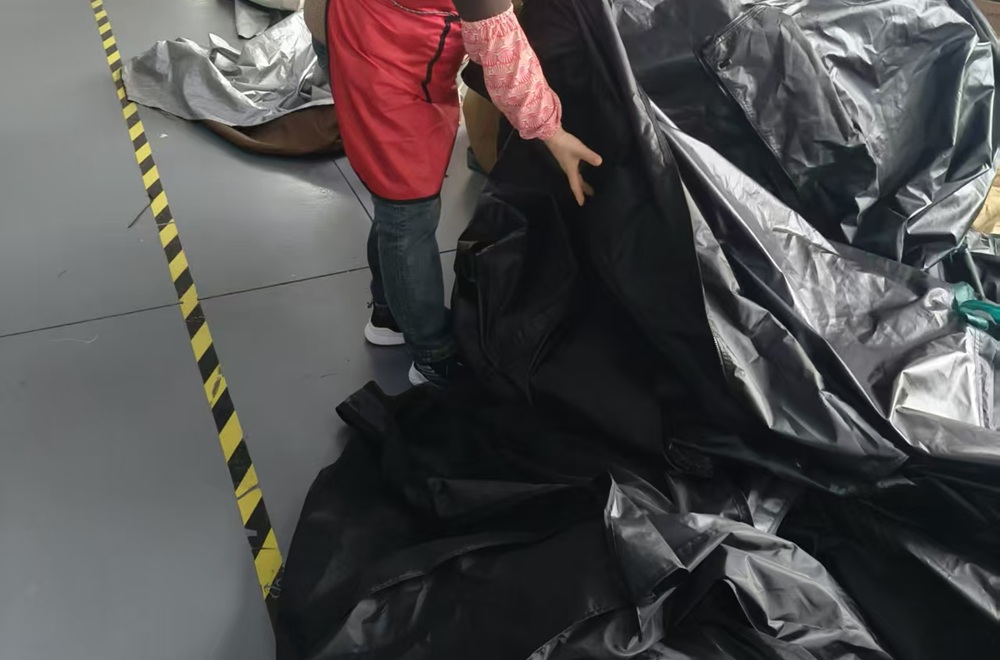
Cost, MOQ, and Supply Chain Feasibility
A technically suitable material may still create commercial challenges.
Before finalizing a floor specification, NastoCamp also considers:
- material availability;
- supplier MOQ;
- customization requirements;
- production cost;
- customer target price.
For example, a special floor color or customized material may be technically possible but create additional supply-chain requirements.
A good OEM recommendation must consider both:
“Can we make this?”
and:
“Does this make sense for the customer’s business?”
Testing and Final Validation
The final recommendation should always be verified through appropriate testing.
Depending on the product, NastoCamp may evaluate:
- material inspection;
- waterproof performance;
- seam and sealing quality;
- finished tent performance;
- customer-specific requirements.
Testing is not only a quality-control activity.
It is also part of product development.
When a test reveals a problem, the manufacturer gains information about:
- material selection;
- construction design;
- production process;
- component compatibility.
This feedback helps improve the final product before mass production.
NastoCamp Manufacturing Perspective
The biggest difference between a material supplier and an experienced OEM manufacturer is the ability to see the complete product.
A material supplier may answer:
“This fabric has the required waterproof rating.”
A manufacturer needs to answer:
“Will this material create a reliable tent floor when combined with this structure, this production process, this target market, and this cost requirement?”
That broader perspective is what helps outdoor brands develop products that perform reliably in real-world use.
Conclusion: Choose the Floor System for the Product
Choosing a tent floor is not about finding the material with the highest specification.
It is about finding the right balance between:
- intended use;
- ground conditions;
- waterproof requirements;
- abrasion resistance;
- tear strength;
- weight targets;
- construction method;
- manufacturing capability;
- cost expectations.
PE, Oxford fabric, nylon, and PVC can all be suitable floor solutions in the right application.
The question is not:
“Which material is the strongest?”
The better question is:
“Which floor system is appropriate for the tent we are developing?”
A lightweight backpacking tent may prioritize:
- low weight;
- compact packing;
- sufficient durability for outdoor travel.
A family camping tent may prioritize:
- durability;
- practical cost;
- easy maintenance.
A heavy inflatable or glamping tent may require:
- stronger materials;
- different joining methods;
- long-term outdoor durability.
A large commercial or humanitarian tent may require:
- reliability;
- cost efficiency;
- stable supply.
Each product has a different engineering objective.
For OEM buyers, the most important lesson is that a tent floor specification should not be evaluated separately from the complete product.
A successful floor system requires alignment between: Material, Construction, Manufacturing Process, Quality Control and Commercial Requirements.
In NastoCamp’s experience, the best results come from early communication between the brand and the manufacturer.
When buyers share:
- target market;
- expected usage;
- performance requirements;
- price objectives;
- product positioning;
the manufacturer can help evaluate whether the proposed specification is technically and commercially appropriate.
The right tent floor is not the one with the highest number on a specification sheet.
It is the one that delivers the required performance, reliability, and value for the product it is designed to become.
FAQ
What is the best material for a tent floor?
There is no single best tent floor material for every application. The right choice depends on the tent type, ground conditions, waterproof requirements, durability needs, manufacturing method and cost target.
Is PE or Oxford better for a tent floor?
PE and Oxford fabrics can both be suitable tent floor options. PE is commonly used where cost efficiency and waterproof performance are important, while Oxford fabrics are often selected when additional durability and fabric strength are required.
What waterproof rating should a tent floor have?
The required waterproof rating depends on the intended use and environment. In NastoCamp’s OEM projects, many tent floor requirements fall within approximately the 2,000–5,000 mm range, but the appropriate specification depends on the complete product design.
Can the tent floor material affect manufacturing?
Yes. Different materials may require different sewing, sealing or welding processes. Material selection should always be considered together with tent construction and manufacturing capability.
Need Help Selecting a Floor System for Your Tent Project?
Developing a custom tent requires more than selecting individual materials.
The floor specification needs to work together with:
- tent structure;
- fabric selection;
- waterproof requirements;
- manufacturing process;
- quality-control standards;
- target market.
At NastoCamp, we work with outdoor brands to evaluate these factors during OEM tent development and help select practical floor solutions based on real production experience.
Whether you are developing a backpacking tent, family camping tent, inflatable tent, glamping structure, or specialized outdoor product, our team can help review the material options and manufacturing approach.
[1] REI Co-op, “What Is a Tent Footprint?” REI explains that a footprint helps protect a tent floor from abrasive ground surfaces and objects such as rocks and sticks.
[2] NEMO Equipment, “Kunai 3–4 Season Backpacking Tent.” Published specifications provide a commercial example of different fabric and waterproof specifications being used for the fly and floor of the same technical tent.
[3] Big Agnes, “Mad House 8.” Published product specifications provide an example of a larger camping tent using a polyester Oxford floor construction.
[4] Advanced Textiles Association, “Heat Sealing Vinyl-Coated Fabric.” The article explains that heat-sealing performance depends on multiple factors including material formulation, fabric construction, temperature, pressure, and processing conditions.
[5] GEAR AID, “How to Repair a Tent Floor or Fabric Coating.” GEAR AID explains that aged polyurethane coatings on outdoor fabrics may experience problems such as peeling, flaking, or sticky degradation, particularly as coatings age.