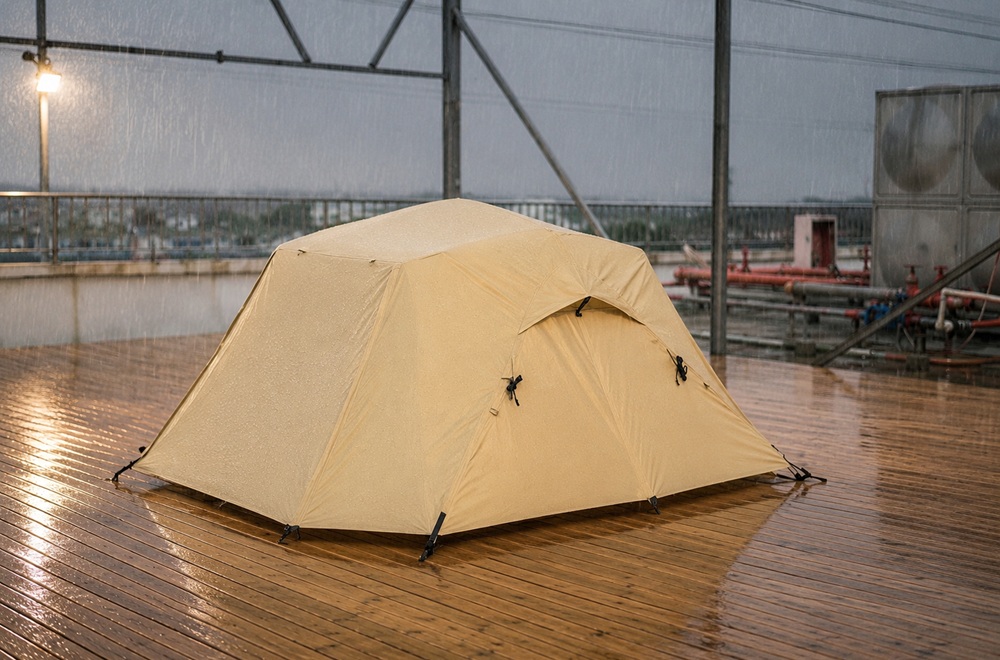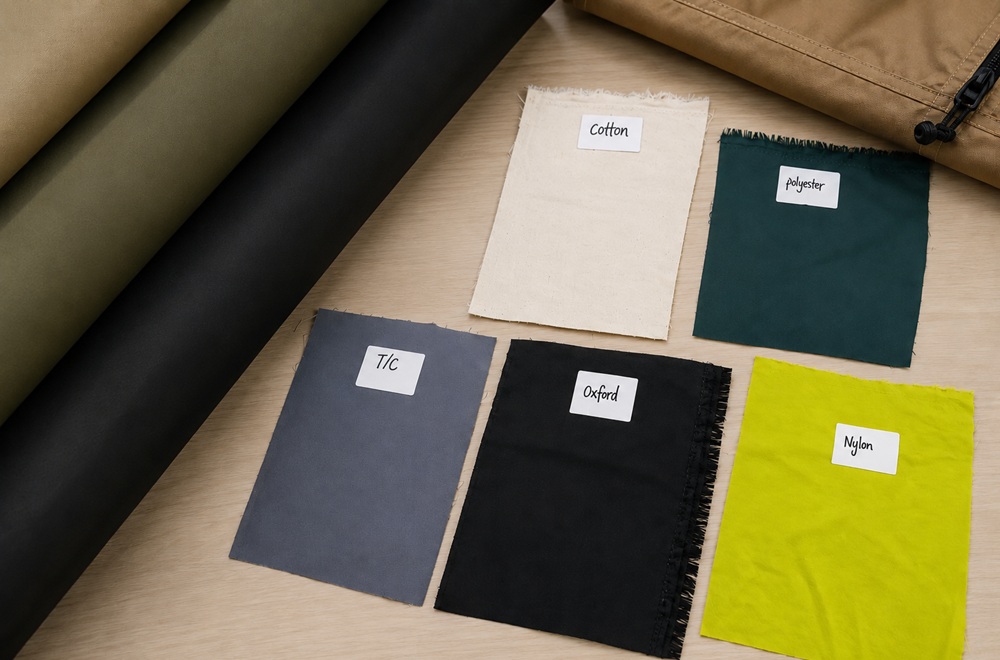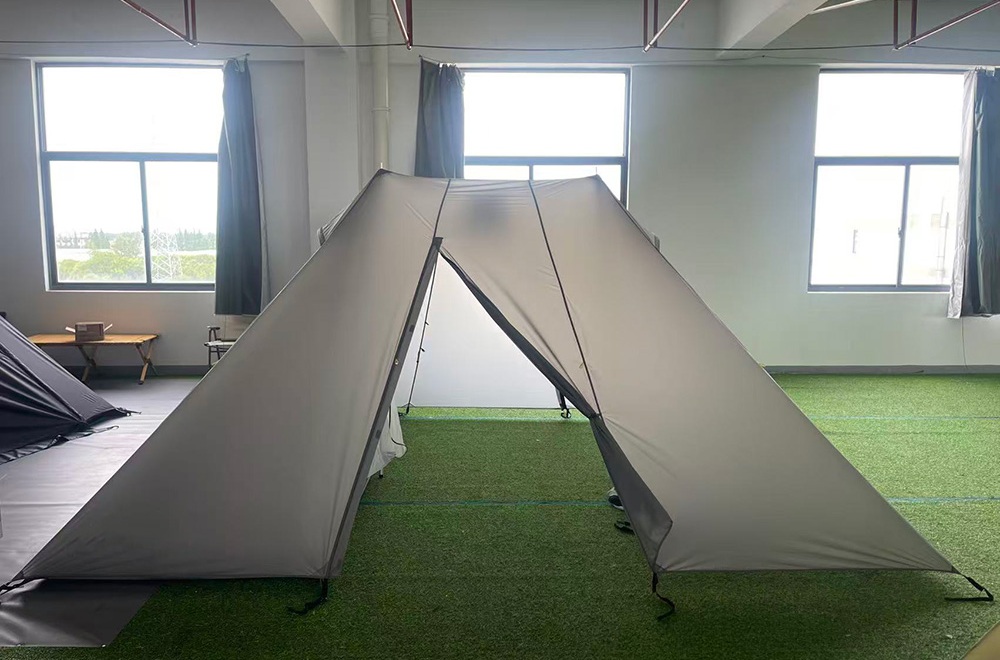
Quick Answer: PU and silicone coatings can both provide strong waterproof performance, but they are suited to different product priorities. PU coating is widely used for standard camping tents, family tents, and cost-sensitive commercial products because it offers a practical balance of performance, manufacturing efficiency, and cost. Silicone-coated fabrics are more commonly considered for ultralight, high-mountain, and other weight-sensitive tents. For OEM buyers, the right choice depends not only on the coating itself, but also on the base fabric, target weight, waterproof requirement, seam-sealing method, printing needs, manufacturing process, and product positioning.
For outdoor brands developing a new tent, choosing the fabric involves more than deciding between polyester and nylon or specifying a waterproof rating. The coating applied to the fabric can also influence how the finished product performs, and how it can be manufactured.
PU (polyurethane) and silicone are two common coating systems used in tent fabrics. At first glance, the comparison may appear straightforward: PU is often viewed as the economical option, while silicone is associated with premium or ultralight tents.
In actual OEM development, however, the decision is more complicated.
A coating that works well for an ultralight backpacking tent may add unnecessary cost or manufacturing complexity to a large family camping tent. Likewise, choosing a coating based only on the highest available waterproof rating may not produce a better finished product.
At NastoCamp, coating selection is therefore considered as part of the broader tent fabric selection process. The intended application, base fabric, finished-product weight, waterproof requirement, manufacturing method, printing needs, and target market all need to be evaluated together.
This article compares PU, silicone, and hybrid coating systems from an OEM manufacturing perspective, and explains how outdoor brands can choose a system that matches the product they actually want to develop.
PU vs Silicone: The Difference Is Not Simply “Good vs Better”
One of the most common ways to compare PU and silicone coatings is to treat them as two performance levels:
PU = economical and lower performance
Silicone = expensive and higher performance
For tent development, this comparison is too simple.
The coating system affects important characteristics of the fabric, but the word “PU” or “silicone” alone does not tell an OEM buyer how waterproof, lightweight, strong, or suitable the finished tent will be.
The complete fabric construction matters.
Both Systems Can Provide Strong Waterproof Performance
Silicone coating is often associated with high-performance tents, but that does not mean a PU-coated fabric is inherently less waterproof.
In NastoCamp’s manufacturing experience, both PU and silicone systems can achieve strong waterproof performance when the material is correctly specified for the product.
This is important because two fabrics described simply as “silicone coated” can still have different waterproof ratings. The same applies to PU-coated fabrics.
For example, technical specifications published for commercial silicone-coated tent fabrics show that different constructions can have different hydrostatic-head values. [1] This demonstrates why the coating name itself should not be treated as the waterproof specification.
For an OEM buyer, the more useful questions are:
- What waterproof performance does the product actually require?
- What is the base fabric?
- What coating construction and specification are being used?
- How will the seams and other potential water-entry points be managed?
- Does the specification match the intended application?
A family camping tent, an ultralight trekking tent, and a high-mountain tent may therefore use very different material systems even when all three need reliable rain protection.
Coating Type Is Only One Part of Tent Waterproof Performance
A tent is not made waterproof by coating alone.
Even when the fabric itself meets the required waterproof specification, the finished tent still contains:
- Seams;
- Stitching holes;
- Zippers;
- Doors and openings;
- Floor-to-wall connections;
- Structural areas where rainwater may accumulate or flow.
The design and manufacturing of these areas can influence how the tent performs in real rain.
This is why NastoCamp does not evaluate waterproof performance only by looking at the coating or a single water-column number.
The fabric specification matters, but so do the tent structure, seam treatment, manufacturing quality, and final product inspection.
For outdoor brands, this distinction is important:
A waterproof fabric specification is a material requirement. Waterproof tent performance is a product-system requirement.
Understanding overall tent waterproof performance is therefore more useful than comparing PU and silicone only by their headline waterproof ratings.
The same principle applies when buyers specify increasingly high water-column values. Higher waterproof ratings may be appropriate for some products, but unnecessarily high specifications can increase cost without creating meaningful value for the intended use.
Where PU Coating Makes More Sense in OEM Tent Development
PU coating remains one of the most widely used options in tent manufacturing, and there is a practical reason for that.
In NastoCamp’s OEM experience, PU-coated fabrics are used more frequently than silicone-coated fabrics across many mainstream tent projects. They can provide the required waterproof performance while offering a practical balance between material cost, manufacturing efficiency, and product positioning.
For many outdoor brands, therefore, choosing PU is not simply about choosing the cheaper option. It can be the more appropriate engineering decision when ultralight performance is not the primary product goal.
Standard Camping and Family Tents
For standard camping tents, family tents, and many recreational shelters, PU-coated fabrics are often a practical starting point.
These products typically need to balance several requirements:
- Reliable rain protection;
- Durability for normal recreational use;
- Reasonable packed weight;
- Manufacturing efficiency;
- Competitive retail pricing.
Unlike an ultralight backpacking tent, where every gram may influence the material specification, a large family tent usually does not need to minimize fabric weight at any cost.
Using a more expensive lightweight silicone-coated fabric system in such a product may therefore provide limited practical benefit if the existing PU-coated fabric already meets the required performance.
This is an important distinction for OEM buyers:
Material specifications should follow the product’s intended use rather than a simple hierarchy of “standard” and “premium” materials.
A well-specified PU-coated fabric can therefore be entirely appropriate for a high-quality commercial camping tent.
Cost-Performance Balance Matters More Than Choosing the “Best” Coating
Cost is a legitimate engineering constraint in OEM product development.
This does not mean selecting the lowest-cost material available. It means deciding where additional material cost produces meaningful value for the target customer.
Consider a recreational garden tent.
If the product’s actual use conditions can be adequately supported by a particular PU-coated fabric specification, increasing the waterproof specification simply because a higher number appears better on a specification sheet may add cost without materially improving the user’s experience.
The opposite is equally important.
If a tent is intended for conditions where a higher level of waterproof performance is genuinely required, under-specifying the fabric simply to reduce cost can create product-quality problems.
NastoCamp therefore evaluates waterproof requirements according to the application rather than automatically recommending the highest available specification.
For OEM buyers, the objective should be:
Specify enough performance for the intended use, with an appropriate margin, rather than paying for specifications the product does not need.
This is especially important for brands managing target retail prices, because every unnecessary material upgrade ultimately affects the finished-product cost.
PU Can Simplify Conventional Manufacturing Processes
Material selection affects more than the finished tent specification. It also affects how the product moves through manufacturing.
In NastoCamp’s production experience, PU-coated fabrics are generally easier to handle than double-sided silicone-coated fabrics during conventional tent production.
This can influence:
- Fabric handling;
- Sewing;
- Production settings;
- Seam treatment;
- Printing and branding processes.
Silicone-coated fabrics can have a noticeably more slippery surface. In actual production, this may require adjustments to sewing-machine settings, needles, fabric handling, and operator technique.
For a conventional tent that does not require an ultralight silicone fabric system, PU can therefore offer a more straightforward manufacturing route.
This becomes particularly relevant when a brand moves from a successful prototype into larger-volume production. A material specification must not only perform well in one sample; the factory must also be able to reproduce the required quality consistently across the production order.
That is why coating selection should be considered together with the overall tent manufacturing process, rather than treated only as a material purchasing decision.
PU Does Not Automatically Mean an Entry-Level Tent
This distinction is important for outdoor brands.
A product can use PU-coated fabric and still be designed and manufactured to a high quality standard.
The final quality of a tent depends on much more than whether its fabric is coated with PU or silicone. It also depends on factors such as:
- Base fabric quality;
- Material specification;
- Structural design;
- Sewing quality;
- Seam treatment;
- Component selection;
- Production consistency;
- Quality control.
For this reason, describing PU as “low-end” and silicone as “high-end” can lead buyers in the wrong direction.
A better distinction is based on product priorities.
For example:
A family camping tent may prioritize space, durability, weather protection, production efficiency, and reasonable cost.
An ultralight trekking tent may prioritize minimum packed weight and a very low-denier fabric system.
Both products can be well engineered.
They simply require different material decisions.
When Should an OEM Buyer Start by Considering PU?
Based on NastoCamp’s project experience, PU-coated fabrics are worth evaluating first when the project involves:
- Standard recreational camping tents;
- Family camping tents;
- Garden or leisure shelters;
- Products where finished weight is not the primary engineering constraint;
- Projects requiring a strong balance between performance and cost;
- Products that benefit from conventional manufacturing, sealing, or printing processes.
This is not a rule that PU must be used in every such product.
Instead, it provides a practical starting point for material evaluation.
The final specification should still be determined by the product’s actual performance requirements, base fabric, structure, target market, and manufacturing method.
Where Silicone Coating Makes More Sense
If PU is a practical choice for many mainstream camping tents, silicone-coated fabric systems become particularly relevant when a project has more demanding weight or performance priorities.
In NastoCamp’s OEM experience, silicone-coated fabrics are more commonly considered for products such as:
- Ultralight backpacking tents;
- Lightweight trekking tents;
- High-mountain tents;
- Products where reducing finished weight is a major design objective.
However, this does not mean that replacing PU with silicone will automatically make a tent lighter or better.
The coating is only one part of the material system.
Ultralight and High-Mountain Tents
Weight plays a very different role in a backpacking tent than it does in a large family tent.
For a family camping product, adding some weight may be acceptable if it supports durability, space, cost control, or other product priorities.
For an ultralight trekking tent, however, every material decision can contribute to the final packed weight.
The brand and manufacturer may therefore need to evaluate:
- Lower-denier fabrics;
- Fabric weight per square meter;
- Coating construction;
- Pole materials and dimensions;
- Zippers and buckles;
- Webbing and other accessories;
- Tent structure itself.
This is where silicone-coated lightweight fabrics become particularly relevant. [1]
In NastoCamp’s experience, silicone systems are commonly considered together with lower-denier nylon when the customer has a demanding finished-weight target.
The important phrase here is “considered together.”
Choosing silicone while retaining a heavy base fabric, heavy structure, or oversized components will not create an ultralight tent by itself.
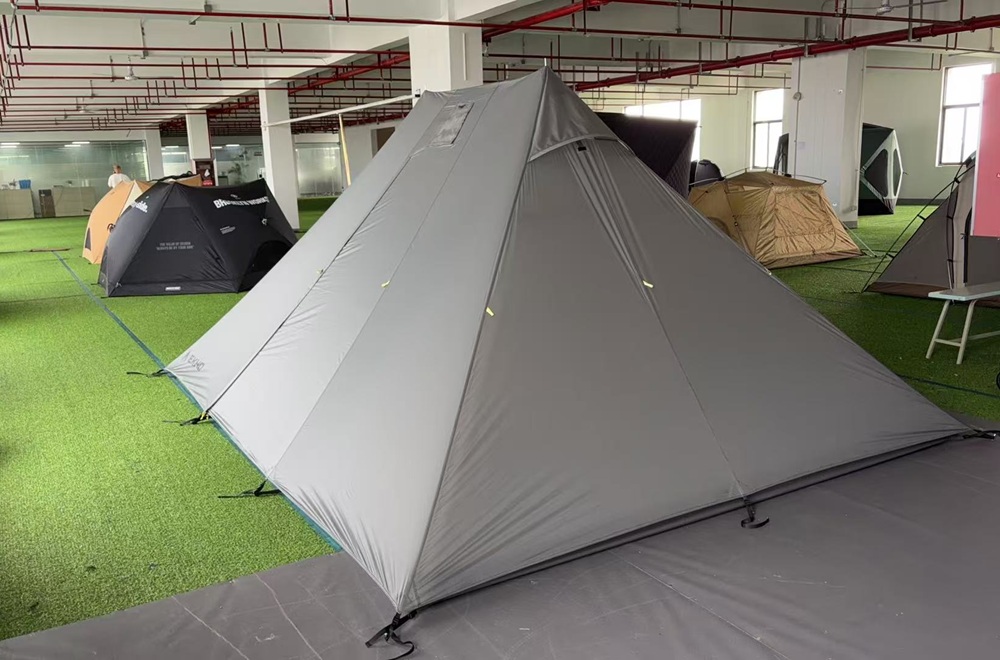
Lightweight Tent Design Is a System Decision
A common mistake is to compare two materials and attribute the entire weight difference to their coatings.
For example:
“Silicone-coated fabric is lighter than PU-coated fabric.”
This statement can be misleading without knowing what is underneath the coating.
A tent fabric specification may include variables such as:
- Nylon or polyester;
- 15D, 20D, 40D, 68D, or another denier;
- Different yarn and weave constructions;
- Different coating weights and methods;
- Single-sided, double-sided, or hybrid coatings.
The finished tent then adds another set of variables:
- Poles;
- Pegs;
- Zippers;
- Buckles;
- Guy lines;
- Mesh;
- Floor fabric;
- Reinforcement materials.
For an outdoor brand trying to reduce the weight of a tent, the correct engineering question is therefore not simply:
“Should we change from PU to silicone?”
It is:
“Where is the weight in the complete product, and which combination of materials and components can reduce it without compromising the required performance?”
This distinction is particularly important in OEM development, where changing one specification can affect other parts of the product.
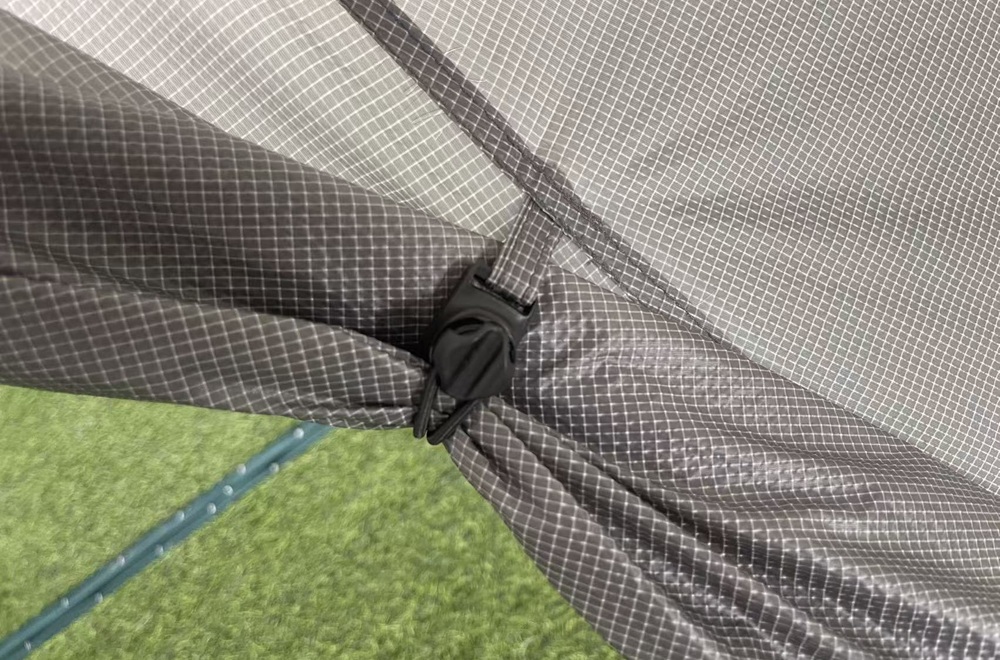
NastoCamp Case: Reducing a Tent to Meet a 1.5 kg Weight Target
A real NastoCamp development project illustrates why coating selection should be considered as part of the complete material system.
The customer had a clear requirement:
The finished tent needed to weigh no more than 1.5 kg.
The initial material solution used:
68D polyester with PU coating.
During development, however, the material system made it difficult to achieve the customer’s finished-weight target.
Instead of simply reducing the coating specification, NastoCamp changed the material strategy.
The revised solution used:
15D ultralight nylon with double-sided silicone coating, together with lightweight components appropriate for the project.
The purpose of this change was not to use silicone because it was considered a more premium coating.
The purpose was to build a complete fabric and component system capable of meeting the customer’s weight requirement.
The final product achieved the required weight target.
This example reflects an important principle in custom tent development:
Start with the product target, then engineer the material system around it.
For this project, the target was finished weight. For another project, the primary constraint might instead be cost, durability, printing, production volume, or another performance requirement.
Silicone Can Offer Advantages Beyond Weight
Silicone-coated fabrics are not used only because of lightweight product development.
Depending on the complete fabric construction, silicone treatment can also contribute to properties such as tear performance and resistance to environmental exposure. [1]
However, these advantages need to be described carefully.
It would be misleading to say:
“Silicone-coated fabric is always stronger than PU-coated fabric.”
A 15D silicone-coated nylon and a heavier PU-coated polyester differ in far more than their coatings.
Fabric strength can also be influenced by:
- Fiber type;
- Yarn quality;
- Denier;
- Weave or ripstop construction;
- Fabric density;
- Coating construction.
For this reason, outdoor brands should compare the complete fabric specification and relevant test results, rather than using coating type as a shortcut for fabric strength.
The same caution applies to UV exposure. Silicone treatment may improve aspects of environmental resistance in some fabric systems, but it does not make a lightweight tent fabric immune to degradation from prolonged sunlight. [1]
The Higher Material Cost Must Solve a Real Product Requirement
In NastoCamp’s sourcing and manufacturing experience, silicone-based ultralight fabric systems generally cost more than standard PU-coated fabric systems.
But even here, the coating should not be treated as the only reason for the price difference.
An ultralight silicone specification may also involve:
- Higher-cost nylon base fabrics;
- Lower-denier technical fabrics;
- More demanding production handling;
- Specialized printing or sealing requirements;
- Different component choices.
For an OEM buyer, the relevant question is therefore not:
“How much more expensive is silicone?”
There is no useful universal percentage.
The better question is:
“What product requirement does this additional material and manufacturing cost allow us to achieve?”
For an ultralight tent competing on packed weight, the additional cost may be justified.
For a large recreational family tent where a conventional PU system already meets the product requirements, the same investment may create little meaningful market value.
When Should an OEM Buyer Start by Considering Silicone?
Based on NastoCamp’s project experience, a silicone-based fabric system is worth evaluating when:
- Finished tent weight is a primary product target;
- The product is designed for ultralight backpacking or trekking;
- A high-mountain tent requires a lightweight performance-oriented material system;
- Lower-denier technical fabrics are being evaluated;
- The target market can support the additional material and manufacturing cost.
However, the final decision should still consider:
- Base fabric;
- Required waterproof performance;
- Seam-sealing method;
- Printing requirements;
- Manufacturing capability;
- Cost target.
Silicone should therefore be selected because it contributes to the product’s engineering goals, not simply because it appears to be the more premium option.
Manufacturing Differences OEM Buyers Often Overlook
Material specifications are often discussed from the perspective of finished-product performance.
For an OEM manufacturer, however, another question is equally important:
How will this fabric behave during production?
Two fabrics that both meet the required waterproof specification may require different approaches to sewing, seam sealing, printing, and production control.
These differences become especially important when a brand moves from prototype development to repeatable mass production.
Silicone-Coated Fabrics Can Be More Demanding to Handle and Sew
In NastoCamp’s production experience, silicone-coated fabrics—particularly fabrics with silicone surfaces on both sides—can be noticeably more slippery than conventional PU-coated fabrics.
That difference may sound minor, but it can affect actual production.
When working with these fabrics, the production team may need to adjust:
- Sewing-machine settings;
- Needle selection or settings;
- Fabric feeding and handling;
- Operator technique.
Experienced workers are particularly important.
A skilled operator who understands how lightweight and slippery fabrics behave can make adjustments during production rather than treating the material like a conventional tent fabric.
This is one reason NastoCamp does not evaluate a fabric only from its supplier specification sheet. The factory must also consider whether the material can be processed consistently at the required production scale.
For OEM buyers, this creates an important distinction:
A fabric that performs well as a material must also be manufacturable consistently as a finished product.
Seam Sealing Depends on the Complete Coating Construction
Seam sealing is one of the most important manufacturing differences OEM buyers should understand.
When a tent is sewn, the needle creates holes through the fabric. Depending on the product design and waterproof requirements, these seams may require additional sealing.
But PU and silicone surfaces do not necessarily use the same sealing chemistry.
Commercial repair and sealing systems illustrate this clearly: products designed for polyurethane-coated tent fabrics are differentiated from sealants designed specifically for silicone-treated fabrics.[2]
This means the factory needs to know more than:
“The fabric is waterproof.”
It needs to know the actual coating construction.
PU-Coated Fabrics
PU-coated surfaces are commonly compatible with polyurethane-based seam-sealing systems.
For many conventional tent products, this makes it possible to integrate seam treatment into established production processes.
The exact method still depends on:
- Fabric construction;
- Coating formulation;
- Seam design;
- Tape or sealant;
- Production equipment.
So even with PU, compatibility should be confirmed rather than assumed.
Double-Sided Silicone Fabrics
A fabric with silicone treatment or coating on both sides presents a different sealing situation.
Conventional polyurethane-based sealing products are not automatically compatible with silicone-treated surfaces. Silicone-treated fabrics require a sealing system designed to bond appropriately to that surface.[2]
For an OEM project, this needs to be considered before the fabric specification is finalized, not after the first production units have already been sewn.
Silicone + PU Hybrid Systems
The choice is not always purely:
PU or silicone.
Tent fabrics can combine different treatments or coatings on different surfaces.
For example, commercial tent constructions exist that combine silicone treatment with a polyurethane waterproof coating and polyurethane seam tape.[3]
This is important because it demonstrates that terms such as:
- “silicone-treated”;
- “silicone-coated”;
- “PU-coated”;
do not always describe the complete construction of the fabric.
For OEM buyers, the practical question should therefore be:
What is applied to each side of the fabric, and which seam-sealing process is compatible with that exact construction?
Why “Silicone Cannot Be Seam Taped” Is Too Simplistic
Because double-sided silicone fabrics require different sealing approaches, it is tempting to turn this into a simple rule:
“Silicone-coated tents cannot be seam taped.”
For OEM product development, that statement is too broad.
The actual answer depends on the complete coating construction.
A double-sided silicone fabric and a hybrid fabric with a PU-compatible surface are not the same manufacturing system.
That distinction matters because an outdoor brand may specify “silicone fabric” while expecting a conventional factory seam-taping process.
If the exact construction is not confirmed early, the material specification and manufacturing requirement may conflict.
The correct workflow is therefore:
Confirm fabric construction → Confirm sealing compatibility → Develop and test the seam process → Approve the production specification
This is a better approach than selecting the fabric first and solving seam compatibility later.
Printing Can Become a Material-Selection Issue
Branding is another production requirement that buyers may overlook when comparing PU and silicone coatings.
A tent may require:
- Brand logos;
- Model names;
- Large graphics;
- Warning information;
- Decorative printing.
According to NastoCamp’s production experience, printing directly onto silicone-coated surfaces can be more difficult than printing onto conventional PU-compatible surfaces.
This does not mean that silicone-coated fabrics cannot be printed.
Rather, the printing method, ink or treatment, fabric surface, and supplier capability need to be evaluated together.
In some projects, the side of the fabric with a PU-compatible surface may be more suitable for conventional printing.
For specialized silicone surfaces, NastoCamp works with suppliers capable of handling certain silicone-fabric printing requirements.
This leads to a practical OEM rule:
If branding or large-area printing is important to the product, confirm printing compatibility before approving the fabric—not after the fabric has been ordered.
This is particularly important for custom products because changing the material after printing trials fail can affect:
- Development time;
- Material purchasing;
- Sample approval;
- Production schedule;
- Cost.
Manufacturing Complexity Matters More When Production Scales Up
A material may work successfully in one prototype but still create challenges when hundreds or thousands of units need to be produced consistently.
This is why OEM material decisions should consider:
- Operator skill requirements;
- Process repeatability;
- Production speed;
- Quality consistency;
- Supplier stability;
- Inspection requirements.
For example, if a lightweight silicone-coated fabric requires more careful handling during sewing, that additional complexity needs to be reflected in production planning and quality management.
The goal is not to avoid technically demanding materials.
The goal is to use them when their performance contribution justifies the additional manufacturing requirements.
For outdoor brands, this is one of the differences between selecting a fabric from a specification sheet and developing a production-ready tent.
What Should Buyers Confirm Before Approving the Fabric?
Before an OEM buyer approves a coated tent fabric, the material discussion should go beyond:
“PU or silicone?”
At minimum, the project team should confirm:
- Base fabric — nylon, polyester, or another textile;
- Denier and fabric weight;
- Coating construction — PU, double-sided silicone, hybrid, or another system;
- Required waterproof performance;
- Seam-sealing method and compatibility;
- Printing and branding requirements;
- Finished-product weight target;
- Manufacturing feasibility;
- Target cost and market positioning.
This information gives the manufacturer a much better basis for recommending a material system.
It also reduces the risk of discovering late in development that the chosen fabric conflicts with another requirement.
PU, Silicone, and Hybrid Systems: A Practical Comparison
The differences between PU and silicone become easier to understand when they are evaluated against actual product-development requirements.
The following table summarizes common tendencies NastoCamp considers during OEM tent development.
These are not absolute material rules. Actual performance depends on the complete fabric construction, including the base textile, denier, coating formulation and weight, seam treatment, and manufacturing process.
| Factor | PU-Coated Fabric | Silicone-Based System | Silicone + PU / Hybrid System |
|---|---|---|---|
| Waterproof potential | Can provide strong waterproof performance when correctly specified | Can provide strong waterproof performance when correctly specified | Can provide strong waterproof performance when correctly specified |
| Typical OEM applications | Standard camping, family and recreational tents | Ultralight, trekking, high-mountain and weight-sensitive tents | Products requiring a combination of performance and manufacturing characteristics |
| Cost tendency | Generally more economical in NastoCamp projects | Generally higher, especially when paired with premium low-denier fabrics | Depends heavily on the specific construction |
| Weight potential | Depends on the complete fabric system | Often paired with lower-denier lightweight fabrics | Depends on the complete fabric system |
| Fabric handling | Generally more straightforward in conventional production | Silicone surfaces can be more slippery and demanding to handle | Depends on which treatments are applied to each surface |
| Seam sealing | Commonly compatible with PU-based systems | Requires a sealing system compatible with the silicone surface | May provide a PU-compatible surface depending on construction |
| Printing | Generally more straightforward on compatible surfaces | Printing directly on silicone surfaces can require specialized processes | Depends on which surface will be printed |
| Manufacturing complexity | Generally lower for conventional tent production | Can require more experienced handling and process adjustment | Depends on the exact coating construction |
| Best reason to choose it | Practical performance-to-cost balance | Weight-sensitive product engineering | Balancing different performance and manufacturing requirements |
The most important point in this comparison is that waterproof potential does not create a simple ranking between the three systems.
An OEM buyer should not read the table as:
PU → Hybrid → Silicone
Good → Better → Best
Instead, each system solves a different combination of product requirements.
Why Hybrid Systems Matter
Hybrid constructions are particularly useful for understanding why “PU vs silicone” is sometimes the wrong way to frame the decision.
A fabric system can combine characteristics of both.
As discussed earlier, commercial tent products exist that use silicone-treated fabric together with a polyurethane waterproof coating and polyurethane seam tape.[3]
Other technical fabrics can also use different treatments on the two sides of the textile to achieve different manufacturing or performance characteristics.[4]
For an OEM buyer, this creates more flexibility.
For example, a project may want some of the characteristics associated with a silicone-treated outer surface while retaining a surface compatible with another sealing or processing method.
The important question is therefore not simply:
“Is this PU or silicone?”
Instead, ask the fabric supplier or manufacturer:
“What is the complete coating construction on each side of the fabric?”
That answer is much more useful when planning:
- Seam sealing;
- Printing;
- Sewing;
- Waterproof performance;
- Production methods.
Compare Complete Fabric Specifications, Not Coating Labels
Imagine that an OEM buyer receives two fabric options:
Option A
68D polyester + PU coating
Option B
15D nylon + double-sided silicone coating
It would be incorrect to attribute every difference between these materials to:
PU vs silicone.
They also differ in:
- Fiber;
- Denier;
- Fabric weight;
- Potential yarn and weave construction;
- Coating construction.
The same principle applies when comparing quotations from different tent manufacturers.
Two suppliers may describe their materials using similar terms while quoting fabrics with very different actual specifications.
For meaningful comparison, an outdoor brand should request enough information to understand what it is actually buying.
Depending on the project, useful specifications may include:
- Base fiber;
- Denier;
- Fabric construction;
- Fabric weight;
- Coating type;
- Coating construction;
- Waterproof rating;
- Relevant strength or performance data;
- Required seam treatment.
This is particularly important during OEM sourcing because a lower quotation is difficult to evaluate if the underlying material specifications are not equivalent.
A Fast Comparison Is Useful, but It Should Not Replace Product Development
Comparison tables are useful for initial sourcing discussions.
But they cannot answer every material question.
For example, knowing that an ultralight project is likely to evaluate silicone-coated low-denier fabric still does not tell the manufacturer:
- What denier should be used?
- Nylon or polyester?
- What waterproof specification is required?
- What coating weight is appropriate?
- How should the seams be sealed?
- Where must the logo be printed?
- What finished weight must the tent achieve?
- What target cost must be maintained?
Those questions require product-level evaluation.
This is why experienced OEM development should move from:
Material category → Detailed specification → Prototype → Testing and adjustment → Approved production specification
rather than treating the first fabric recommendation as the final answer.
Common Buyer Mistakes When Selecting Tent Coatings
Many coating-selection problems begin with a technically correct piece of information that is taken too far.
Silicone-coated fabrics are widely used in ultralight tents. PU-coated fabrics are widely used in mainstream camping tents. Higher waterproof ratings can provide greater resistance to water pressure.
But none of these facts means that one specification should automatically be applied to every tent.
From an OEM perspective, the following mistakes can lead to unnecessary cost, unsuitable materials, or problems later in product development.
Mistake 1: Assuming Silicone Is Always More Waterproof
One of the easiest assumptions to make is:
“If silicone is the more premium option, it must also be more waterproof.”
That is not a reliable way to specify a tent fabric.
As discussed earlier, silicone-coated fabrics themselves are available with different hydrostatic-head values.[1] PU-coated fabrics can also be engineered to meet demanding waterproof requirements.
The coating type and waterproof rating are therefore two related—but different—parts of the specification.
Instead of asking:
“Which coating is more waterproof?”
an OEM buyer should ask:
“What waterproof performance does this product require, and which fabric system can reliably achieve it?”
This shifts the decision from material reputation to measurable product requirements.
Mistake 2: Specifying a Higher Waterproof Rating Simply Because It Sounds Better
More is not always more useful.
NastoCamp sometimes sees projects where the waterproof specification is higher than the intended application realistically requires.
Consider a garden or recreational tent.
If the product’s actual use conditions can already be supported by the selected material system, increasing the waterproof specification simply to place a larger number on the specification sheet can add unnecessary cost.
At the same time, the opposite mistake is equally problematic.
If the intended use genuinely requires a higher level of rain protection, reducing the specification purely to achieve a lower quotation can create a product that does not meet the brand’s performance expectations.
The correct objective is therefore neither:
“Use the highest specification possible.”
nor:
“Use the cheapest specification possible.”
It is:
Specify the performance the product actually needs.
This is why higher waterproof ratings should always be evaluated in the context of the tent’s intended use, construction, target market, and overall waterproof system.
Mistake 3: Attributing the Entire Weight Difference to the Coating
Suppose one tent uses:
68D polyester + PU
and another uses:
15D nylon + double-sided silicone.
If the second fabric system is significantly lighter, it would be tempting to conclude:
“Silicone made the tent lighter.”
But the comparison has changed several variables at once.
The fabrics differ in:
- Fiber type;
- Denier;
- Fabric weight;
- Coating construction.
And the finished tents may also use different poles, zippers, mesh, pegs, and accessories.
NastoCamp’s ≤1.5 kg development case demonstrates exactly this issue. The project achieved its target by changing the complete material and component strategy, not by treating silicone coating as an isolated weight-saving feature.
For brands developing ultralight products, this distinction matters because focusing on one specification can hide larger weight-saving opportunities elsewhere in the product.
Ultralight tent development is a system-engineering problem, not a coating-selection shortcut.
Mistake 4: Selecting the Fabric Before Confirming Seam Sealing and Printing
A fabric may look ideal on a technical data sheet but create problems if other manufacturing requirements have not been considered.
Two particularly important questions are:
How will the seams be sealed?
and:
How will the product be printed?
As discussed earlier, polyurethane-coated and silicone-treated surfaces do not necessarily use interchangeable sealing systems.[2]
Printing also needs to be considered early. Based on NastoCamp’s production experience, printing directly onto silicone surfaces can require different processes or specialized supplier capability.
Imagine that a brand approves and orders a fabric before confirming these requirements.
Later, the factory discovers that:
- The planned sealing process is incompatible with the surface;
- The required logo cannot be reliably produced using the intended printing method;
- A different material construction is needed.
At that point, what began as a material-selection issue can become a:
Development delay → Material purchasing problem → Cost increase → Production schedule problem
A better sequence is:
Define product requirements → Confirm fabric construction → Confirm sealing and printing compatibility → Make and evaluate the sample → Approve the production specification
Mistake 5: Treating PU and Silicone as the Only Two Choices
The title of this article compares PU and silicone because those are two coating systems buyers frequently encounter.
Actual tent-fabric engineering is not always binary.
Hybrid and asymmetric constructions can combine different treatments on different sides of the fabric.
Big Agnes, for example, publishes a commercial tent construction using silicone-treated nylon together with a polyurethane waterproof coating and polyurethane seam tape.[3]
Technical-textile suppliers also offer asymmetric constructions, such as a fabric with silicone on the outside and a PU-like coating on the inside.[4]
These examples matter because they show why an OEM buyer should avoid specifying only:
“We want silicone fabric.”
A more useful specification would clarify:
- Base textile;
- Denier;
- Coating construction;
- Which treatment is applied to each side;
- Waterproof requirement;
- Seam-sealing requirement;
- Printing requirement.
That gives the manufacturer enough information to evaluate the fabric as a complete production system.
Mistake 6: Comparing Supplier Quotations Without Comparing the Actual Fabric Specification
This mistake extends beyond coating selection.
Two tent manufacturers may both quote:
“PU-coated polyester”
or:
“Silicone-coated nylon”
while the actual materials behind those descriptions are different.
Differences may include:
- Denier;
- Yarn quality;
- Fabric weight;
- Weave construction;
- Coating specification;
- Waterproof performance;
- Material supplier;
- Quality consistency.
As a result, two quotations that appear to describe the same tent may not represent equivalent products.
This is especially important when buyers compare prices using only product photographs.
A photograph cannot reliably show the coating construction, fabric weight, waterproof performance, or many other material differences.
For serious OEM sourcing, quotations should therefore be compared against a sufficiently detailed product specification.
Compare specification against specification—not price against price alone.
How Should OEM Buyers Choose Between PU and Silicone?
Once the common misconceptions are removed, coating selection becomes much more straightforward.
Instead of beginning with:
“Do we want PU or silicone?”
NastoCamp recommends beginning with the product itself.
The following framework can be used during early OEM development.
Step 1: Define the Intended Application
Start with where and how the tent will actually be used.
For example:
- Family camping;
- Recreational camping;
- Garden or leisure use;
- Backpacking;
- Long-distance trekking;
- High-mountain use.
The application establishes the context for almost every material decision that follows.
A large family tent and an ultralight trekking tent should not be expected to use the same material logic simply because both need to keep rain out.
Step 2: Define the Finished-Product Weight Target
Ask whether weight is:
A primary engineering constraint
or:
A secondary consideration.
If a backpacking brand needs the complete tent below a specific weight target, lower-denier lightweight fabrics and silicone-based systems may become highly relevant.
If the product is a large family tent transported mainly by car, reducing every possible gram may offer little value compared with other priorities.
A numerical finished-product target is much more useful to the manufacturer than simply saying:
“We want a lightweight tent.”
It allows the development team to evaluate where weight can realistically be reduced.
Step 3: Define the Required Waterproof Performance
Specify the performance required for the intended use rather than automatically requesting the highest available number.
This discussion should consider:
- Intended weather exposure;
- Tent structure;
- Flysheet and floor requirements;
- Seam construction;
- Overall waterproof design.
Remember:
The fabric’s waterproof rating is one input into the tent’s waterproof system—not the complete answer.
Step 4: Define the Base Fabric Before Judging the Coating
The manufacturer needs to understand what textile system is being considered.
Relevant variables can include:
- Nylon or polyester;
- Denier;
- Fabric weight;
- Weave or ripstop construction.
Only then does the coating specification become meaningful in context.
For example:
15D nylon + silicone
and:
68D polyester + PU
are not simply two different coatings.
They are two different fabric systems.
Step 5: Confirm Seam Sealing, Printing, and Other Production Requirements
Before approving the fabric, confirm how the finished tent needs to be manufactured.
Important questions include:
- Will the seams require tape or another sealing method?
- Is that sealing method compatible with the selected surface?
- Where will logos be printed?
- How large are the printed areas?
- Can the selected printing process work reliably with the coating?
- Does the material require specialized handling during production?
These questions can prevent a technically attractive fabric from creating avoidable problems later in development.
Step 6: Define the Target Cost and Market Positioning
Finally, evaluate whether the material system makes commercial sense.
A brand developing a premium ultralight trekking tent may be willing to accept:
- More expensive technical fabric;
- More demanding manufacturing;
- Specialized processing;
because minimum weight is part of the product’s market value.
A mainstream family camping product may create greater customer value by allocating cost toward:
- More usable space;
- Better structure;
- Better poles;
- Improved ventilation;
- More convenient features;
rather than paying for an ultralight fabric system the end user does not need.
This is why cost engineering is not simply about making the product cheaper.
It is about:
Putting the product budget into the specifications that matter most to the target customer.
Quick Decision Table for OEM Buyers
| If Your Priority Is… | Start by Evaluating… | Also Confirm… |
|---|---|---|
| Standard camping tent | PU-coated fabric | Required waterproof performance and cost target |
| Family camping tent | PU-coated fabric | Structure, durability and total product cost |
| Garden / recreational shelter | PU with an appropriate specification | Avoid unnecessary over-specification |
| Cost-performance balance | PU | Actual performance requirements |
| Ultralight backpacking tent | Silicone-based lightweight fabric system | Denier, total fabric weight and components |
| High-mountain lightweight tent | Silicone-based system | Complete performance specification |
| Very low finished-weight target | Low-denier fabric + silicone system + lightweight components | Weight contribution of the whole tent |
| Conventional seam-taping requirement | PU-compatible surface | Exact coating construction |
| Significant logo / graphic printing | Verify printable surface before material approval | Printing process and supplier capability |
| Mixed performance and manufacturing requirements | Hybrid system | Treatment on each side of the fabric |
| High waterproof requirement | PU or silicone may both be possible | Required rating and complete tent construction |
Important: This table is a starting point for product development, not a substitute for testing or project-specific material evaluation.
The Most Useful Information to Send Your Tent Manufacturer
If an outdoor brand is asking a manufacturer to recommend the coating system, a useful initial brief should include:
- Tent type and intended application
- Target market
- Target finished weight
- Preferred base fabric, if already known
- Required waterproof performance
- Expected retail or product positioning
- Printing and branding requirements
- Any required seam-treatment method
- Target order quantity
- Target cost, where possible
The buyer does not necessarily need to know the final fabric specification before contacting the factory.
That is part of what an experienced OEM development team should help determine.
But the clearer the product target is, the easier it becomes to recommend a material system that solves the right problem.
What We Evaluate Before Recommending a Tent Fabric Coating
When an outdoor brand approaches NastoCamp with a new tent project, the material discussion does not normally begin and end with:
“PU or silicone?”
The coating is only one variable in the complete product specification.
Before recommending a fabric system, we typically evaluate the product from several connected perspectives.
Product Type and Intended Use
The first question is what the tent is being designed to do.
A family camping tent, an ultralight trekking tent, a high-mountain tent, and a recreational shelter can have very different priorities.
The intended use helps determine which specifications deserve the most attention.
For one project, that may be minimum weight.
For another, it may be cost control, weather protection, durability, space, or manufacturing efficiency.
Target Weight and Base Fabric
If weight is important, we evaluate the coating together with the base fabric rather than separately.
That can include:
- Nylon or polyester;
- Denier;
- Fabric weight;
- Coating construction;
- Other components contributing to finished weight.
The ≤1.5 kg project discussed earlier is a good example. The solution was not simply to replace PU with silicone. The material system moved from 68D polyester + PU to 15D ultralight nylon + double-sided silicone, together with lightweight components.
The product target determined the material decision.
Required Performance, Not Maximum Specification
The next question is what level of performance the product actually requires.
For waterproofing, this means avoiding both:
Under-specification, which may cause the finished tent to perform below the brand’s requirements;
and:
Over-specification, which may increase cost without providing meaningful additional value for the intended application.
The same principle applies more broadly to product development:
The objective is not to maximize every specification. It is to balance the specifications around the intended product.
Manufacturing Feasibility
A material also needs to work in production.
Depending on the coating construction, we may need to evaluate:
- Fabric handling;
- Sewing;
- Seam sealing;
- Printing;
- Operator requirements;
- Process consistency.
This becomes particularly important when moving from sample development into mass production.
A material that works for one carefully made prototype must also be capable of delivering consistent quality across the production order.
Cost and Market Positioning
Finally, the material system needs to make commercial sense for the brand.
A premium ultralight product may justify a more expensive fabric system because low weight is part of its competitive value.
A mainstream recreational tent may benefit more from investing the same budget elsewhere in the product.
The objective is not to make every project as inexpensive as possible.
It is to find an appropriate balance between:
Performance + Quality + Manufacturing + Cost
for the product the brand is trying to sell.
NastoCamp Manufacturing Insight
Based on our OEM experience, coating selection is rarely an isolated material decision.
We evaluate the coating together with the base fabric, finished-product weight target, waterproof requirement, sewing and sealing process, printing needs, manufacturing feasibility, and final market positioning.
This is also why two customers asking for apparently similar tents may ultimately receive different material recommendations.
Their product goals may not be the same.
Conclusion: Choose the Coating for the Product, Not the Label
PU and silicone coatings can both be part of high-quality tent fabric systems.
The difference is not simply:
PU = basic
Silicone = premium
PU-coated fabrics remain a practical choice for many standard camping, family, recreational, and cost-sensitive commercial tent projects.
Silicone-based systems become particularly relevant when lightweight performance is a major engineering priority, especially when combined with appropriate lower-denier fabrics and lightweight components.
Hybrid systems add another option when different coating surfaces can help balance performance and manufacturing requirements.
The most important lesson for an OEM buyer is therefore simple:
Do not select the coating before defining the product.
Start with:
Application → Weight → Waterproof Performance → Base Fabric → Manufacturing Requirements → Cost
and then determine which material construction best supports those requirements.
The best coating is not the one with the highest specification or the most premium reputation.
It is the coating system that allows the complete tent to meet its intended performance, weight, cost, and manufacturing targets.
Need Help Selecting a Fabric System for Your Tent Project?
If your brand is developing a custom tent and you are unsure whether PU, silicone, or a hybrid coating system is more appropriate, NastoCamp can evaluate the material together with the product structure, target weight, waterproof requirements, printing needs, and manufacturing process.
Whether you are developing a standard camping tent or a weight-sensitive technical product, the goal is to select a fabric system that fits the complete product specification—not simply the most impressive material label.
References
[1] Extremtextil. Technical specifications for silicone-coated nylon tent fabrics. See Ripstop Nylon Tent Fabric, Silicone Coated, 20den, 36 g/sqm (20D, 36 g/m², 2,000 mm water column) and Ripstop Nylon Tent Fabric, Silicone Coated, 40den, 55 g/sqm (40D, 55 g/m², 3,500 mm water column). Accessed August 2026.
[2] GEAR AID. Tent fabric and seam-sealant compatibility guidance. See Seam Grip TF Tent Fabric Sealant for polyurethane-coated tent fabrics and Seam Grip SIL Silicone Sealant for silicone-treated fabrics. Accessed August 2026.
[3] Big Agnes. “Copper Hotel HV UL3 Accessory Rainfly.” The published material specification describes a silicone-treated ultralight nylon fly with a 1200 mm polyurethane waterproof coating and waterproof polyurethane-taped seams. Accessed August 2026.
[4] Extremtextil. “Ripstop-Nylon Tent Fabric, Silicone/UTS-Coated, 20den, Recycled, 50 g/sqm.” Technical specifications for an asymmetric tent fabric using a silicone coating on the outside and a PU-like UTS coating on the inside. Accessed August 2026.