Quick Answer:
A successful custom inflatable tent project requires more than producing a prototype. Outdoor brands need an OEM partner who can support product development, sample improvement, manufacturing preparation, and mass production. This case study shows how NastoCamp helped develop a custom sports viewing tent from an urgent prototype request into a production-ready product.
Introduction
For outdoor brands, developing a new product often starts with an idea.
It may come from:
- A market opportunity;
- A customer demand;
- A unique product concept;
- A need to create differentiation from competitors.
However, turning an idea into a successful outdoor product requires more than simply producing a sample.
A professional custom tent development process involves multiple stages:
- Understanding product requirements;
- Evaluating design feasibility;
- Developing prototypes;
- Improving the product through communication;
- Preparing for consistent mass production.
A sample is only the beginning of product development.
The real challenge is transforming a prototype into a reliable product that can be manufactured consistently at scale.
This case study shares how NastoCamp supported the development of a custom inflatable sports viewing tent, from an urgent prototype request to a full production project.
Project Background: Developing a Custom Sports Viewing Tent
Outdoor brands often look for customized products that can create unique value in competitive markets.
Compared with standard camping tents, a custom sports viewing tent has different requirements.
It is not only a shelter product, but also a product designed around a specific user experience.
For this project, the customer was looking for a customized solution from an experienced inflatable tent manufacturer that could support sports viewing applications.
The product needed to achieve a balance between:
- Brand presentation;
- Functional space;
- Structural stability;
- User comfort;
- Production feasibility.
Understanding the Product Requirements
At the beginning of the project, the customer provided their product concept and development requirements.
Like many customized OEM projects, the challenge was not simply making a tent based on an existing model.
The manufacturer needed to understand:
- How the product would be used;
- What size and structure were required;
- What appearance the brand expected;
- How the product could be produced efficiently.
For inflatable tents, additional considerations are required compared with traditional pole tents.
The development team needs to evaluate:
- Air beam structure;
- Overall shape stability;
- Fabric selection;
- Connection methods;
- Production processes.
Why Inflatable Sports Viewing Tents Require Professional Development
Inflatable tents have become increasingly popular for applications such as:
- Sports events;
- Outdoor activities;
- Brand promotions;
- Temporary viewing spaces.
However, developing an inflatable tent for commercial use requires more than creating a visually attractive design.
A production-ready inflatable tent must consider:
Structural Performance
The inflatable structure needs to maintain its shape and stability after inflation.
Material Compatibility
Different fabrics and inflatable components need to work together to achieve:
- Durability;
- Reliable performance;
- Consistent appearance.
Manufacturing Feasibility
A design that looks good in concept must also be practical for:
- Cutting;
- Sewing;
- Assembly;
- Quality inspection.
From Product Idea to Engineering Evaluation
One important role of an experienced OEM manufacturer is supporting custom tent development and helping brands evaluate whether a product idea can become a practical product.
During development, manufacturers may identify:
- Potential production challenges;
- Structural improvements;
- Cost optimization opportunities.
The goal is not only to make the sample look similar to the original idea.
The goal is to create a product that can be successfully produced and delivered to the market.
From Concept to Prototype: Rapid Inflatable Tent Sample Development
After the initial product requirements were confirmed, the next challenge was transforming the customer’s concept into a physical prototype.
For many outdoor brands, tent samples and prototype development are some of the most important parts of product development.
A prototype allows both the brand and the manufacturer to evaluate:
- Product appearance;
- Structural design;
- Functional performance;
- Manufacturing feasibility.
However, developing a custom inflatable tent prototype within a short timeline requires more than simply speeding up production.
It requires:
- Fast communication;
- Engineering coordination;
- Material preparation;
- Clear decision-making.
Responding to an Urgent Development Timeline
During this project, the customer had a very tight schedule and needed a custom inflatable tent sample completed within a short timeframe.
The challenge was not only producing the tent quickly.
The team also needed to ensure that the prototype accurately reflected the customer’s requirements.
The development process involved close coordination between:
- Customer communication;
- Engineering evaluation;
- Pattern development;
- Material preparation;
- Production team execution.
Turning Requirements Into a Production-Ready Prototype
For a customized inflatable sports viewing tent, several technical aspects needed to be considered during prototype development.
The development team focused on:
Structure Confirmation
The inflatable structure needed to achieve the expected shape and appearance while maintaining stability.
Material Coordination
The selected materials needed to balance:
- Product appearance;
- Durability;
- Manufacturing requirements.
Manufacturing Feasibility
The prototype also needed to consider future production requirements.
A sample that looks good is not enough.
It must also be suitable for:
- Repeatable manufacturing;
- Quality control;
- Future mass production.
Fast Development Through Effective Coordination
Completing a prototype quickly does not mean skipping important steps.
Instead, an experienced OEM manufacturer needs to organize the process efficiently.
For this project, NastoCamp focused on:
- Quickly understanding the customer’s expectations;
- Coordinating the required resources;
- Completing the prototype within the required timeframe;
- Preparing the foundation for further product development.
Beyond a Sample: Validating the Product Concept
The purpose of a prototype is not only to provide a physical sample.
More importantly, it allows the brand and manufacturer to confirm:
- Whether the concept works in practice;
- Whether the structure meets expectations;
- Whether improvements are needed before production.
A successful prototype creates confidence for the next stage of custom tent development: moving from product validation into production preparation.
Improving the Product Through Communication and Testing
A successful OEM custom tent development project is not completed when the first prototype is finished.
The prototype stage provides an opportunity for both the brand and the manufacturer to review the product, identify possible improvements, and confirm that the final design can meet market expectations.
For customized outdoor products, communication between the customer and manufacturer plays an important role in achieving the right balance between:
- Product concept;
- User experience;
- Manufacturing feasibility;
- Cost control.
Why Prototype Feedback Matters
When customers review tent samples, they can evaluate details that are difficult to confirm through drawings or product images alone.
During this stage, brands may review:
- Overall appearance;
- Internal space;
- Product dimensions;
- Structural design;
- Material performance;
- Practical usage experience.
This feedback helps the manufacturer understand whether the prototype fully matches the original product expectations.
Adjusting the Product Before Mass Production
One of the advantages of professional OEM development is the ability to identify and solve problems before mass production begins.
During prototype evaluation, possible improvements may include:
- Adjusting dimensions;
- Optimizing structural details;
- Improving usability;
- Reviewing material choices;
- Making production processes more efficient.
These improvements are valuable because changes made during the prototype stage are much easier to manage than changes made after mass production starts.
Balancing Brand Requirements and Manufacturing Reality
Outdoor brands often have a clear vision of the product they want to create.
However, turning a concept into a manufacturable product requires professional manufacturing experience.
An experienced OEM partner can help evaluate:
- Whether the structure is practical;
- Whether materials are suitable;
- Whether production costs match expectations;
- Whether the design can be manufactured consistently.
The goal is not simply to make a product that looks good in a prototype.
The goal is to create a product that can perform well in the market and be produced reliably.
Building Confidence Before Production
Through continuous communication and prototype improvement, both the brand and manufacturer can reach a clearer understanding before entering mass production.
This process helps reduce risks related to:
- Product quality;
- Manufacturing difficulties;
- Unexpected cost increases;
- Production delays.
For outdoor brands, choosing a manufacturer that can participate in product development—not only production—can make the entire OEM journey more efficient.
From Approved Sample to Mass Production
For a custom OEM project, prototype approval is an important milestone, but it is not the final goal.
The real challenge begins when the product needs to move from a single prototype into consistent mass production.
A successful transition from sample to production requires manufacturers to coordinate:
- Materials;
- Production planning;
- Manufacturing processes;
- Quality control;
- Final product consistency.
For this custom inflatable sports viewing tent project, the successful prototype provided the foundation for moving into large-scale production.
Preparing for Production After Sample Approval
Once the sample was confirmed, the project moved into the production preparation stage.
Unlike prototype development, mass production requires a more systematic approach.
The manufacturing team needed to prepare:
Material Supply
Including:
- Tent fabrics;
- Inflatable components;
- Accessories;
- Other customized materials.
Materials need to be prepared according to the approved product specifications to ensure consistency across production units.
Production Planning
Before manufacturing begins, the factory needs to arrange:
- Production schedule;
- Worker allocation;
- Manufacturing procedures;
- Quality checkpoints.
This ensures that every production stage follows the approved sample requirements.
Scaling From One Sample to Multiple Production Units
Producing one prototype and producing hundreds of products require different capabilities.
During prototype development, the focus is:
Can this product be successfully created?
During mass production, the focus becomes:
Can this product be produced consistently?
This requires:
- Standardized processes;
- Experienced production workers;
- Clear quality requirements;
- Effective production management.
For inflatable tents, maintaining consistency is especially important because each product needs to achieve:
- Similar appearance;
- Reliable inflatable structure;
- Stable performance;
- Consistent workmanship.
Production Management During Manufacturing
During the mass production stage, different departments need to work together.
The complete tent manufacturing process may involve:
- Material inspection;
- Cutting;
- Component preparation;
- Sewing and assembly;
- Product inspection;
- Packaging preparation.
Each stage affects the final product quality.
A professional OEM manufacturer does not only focus on production speed.
It focuses on producing products that meet the approved requirements consistently.
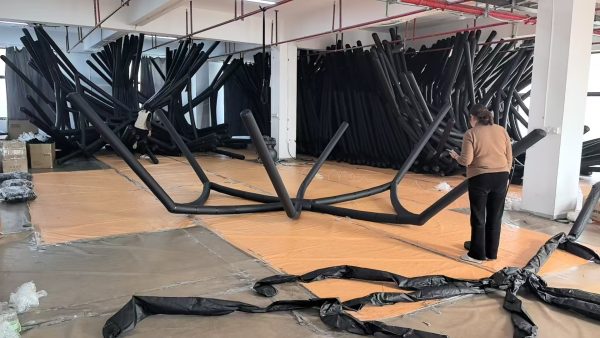
Real Production Progress After Prototype Approval
The photos below show the project after moving into the mass production stage.
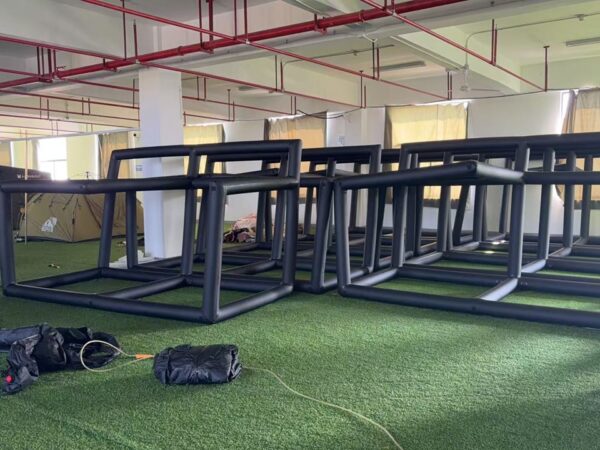
Compared with the prototype phase, the production stage requires:
- More materials;
- More production coordination;
- More quality control;
- More attention to consistency.
This transition demonstrates an important difference between a supplier who can make samples and an experienced OEM tent manufacturer who can support complete product development and manufacturing.
Key Manufacturing Challenges of Inflatable Tent Production
Inflatable tents offer unique advantages for outdoor brands.
Compared with traditional pole tents, inflatable structures can provide:
- Faster setup;
- Larger interior space;
- Unique visual appearance;
- Flexible application scenarios.
However, producing inflatable tents for commercial use also creates specific manufacturing challenges.
A prototype may demonstrate that a product concept works, but successful mass production requires additional attention to:
- Structural consistency;
- Material performance;
- Manufacturing precision;
- Quality control.
Challenge 1: Maintaining Inflatable Structure Consistency
One of the key differences between inflatable tents and traditional tents is the air-supported structure.
The inflatable system needs to maintain:
- Correct shape;
- Stable pressure;
- Reliable performance during use.
During mass production, each inflatable component must be manufactured consistently.
Small differences in:
- Dimensions;
- Fabric cutting;
- Connection points;
- Assembly process;
may affect the final product appearance and performance.
Therefore, production accuracy is important when scaling from one prototype to multiple units.
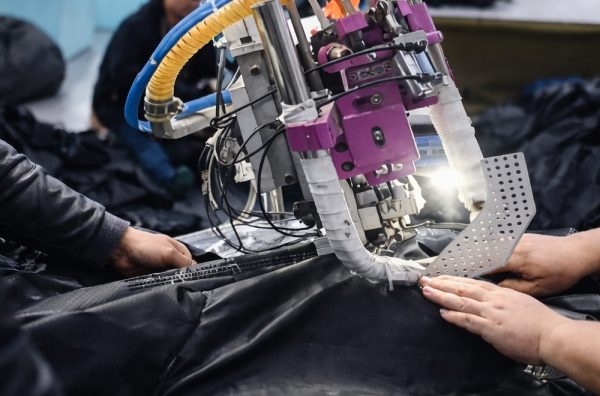
Challenge 2: Material Selection and Welding Quality
Inflatable tents rely heavily on material performance.
The combination of:
- Outer fabric;
- Air tube materials;
- Connection methods;
directly affects product durability and reliability.
During manufacturing, attention needs to be given to:
- Material compatibility;
- Processing accuracy;
- Welding quality;
- Finished product inspection.
A well-designed inflatable tent requires not only suitable materials but also proper manufacturing execution.
Challenge 3: Balancing Design Requirements and Production Feasibility
Many outdoor brands start with a strong product vision.
They may focus on:
- Appearance;
- Brand differentiation;
- User experience.
However, professional OEM development also requires evaluating whether the design can be manufactured efficiently.
During production preparation, manufacturers need to consider:
- Production methods;
- Material availability;
- Manufacturing difficulty;
- Cost control.
The goal is not to simplify the product idea.
The goal is to find a practical solution that maintains the original design intention while allowing stable production.
Challenge 4: Maintaining Quality Consistency During Mass Production
A prototype represents one product.
Mass production requires every unit to meet the same expectations.
This requires a structured tent manufacturing process with standardized production procedures, experienced workers, quality inspection procedures, and clear production requirements.
For customized inflatable tents, quality control should continue throughout the production process, including:
- Incoming material inspection;
- Production checks;
- Finished product inspection.
This helps ensure that the final products remain consistent with the approved sample.
Why Manufacturing Experience Matters
The transition from prototype to mass production is where manufacturing experience becomes especially important.
A factory that can create a sample may not always have the capability to manage large-volume production and maintain consistent tent quality requirements.
For outdoor brands, choosing an OEM partner with both development experience and production capability can reduce risks during product launch.
Project Outcome: From Prototype to Production Partnership
A successful OEM project is not defined only by whether a sample can be completed.
The real value of custom tent development comes from whether the product can successfully move from:
Concept
↓
Prototype Development
↓
Product Validation
↓
Mass Production
↓
Market Launch
For this custom inflatable sports viewing tent project, NastoCamp supported the customer through the complete development journey, helping transform an initial product requirement into a production-ready solution.
Moving Beyond Sample Development
The initial challenge of this project was developing a custom inflatable tent prototype within a demanding timeline.
However, the long-term goal was not simply to create a sample.
The objective was to develop a product that could:
- Meet the customer’s design expectations;
- Achieve reliable manufacturing performance;
- Maintain consistent quality during production;
- Support future commercial use.
This required close cooperation between the customer and NastoCamp throughout the development process.
The Importance of a Complete OEM Capability
This project demonstrates an important difference between a manufacturer who can produce samples and an OEM partner who can support product development at scale.
A complete OEM capability requires more than production equipment.
It requires:
Product Development Experience
Understanding how to transform ideas into practical products.
Engineering Support
Evaluating structures, materials, and manufacturing feasibility.
Production Management
Ensuring the product can be produced consistently after approval.
Maintaining product standards from prototype to final production.
Building Long-Term Value for Outdoor Brands
For outdoor brands, choosing a manufacturing partner is not only about completing one order.
A reliable OEM partner can help brands:
- Develop differentiated products;
- Reduce development risks;
- Improve product feasibility;
- Build a stable supply chain.
The transition from prototype to mass production shows whether a manufacturer truly understands both product development and manufacturing execution.
What This Case Demonstrates
Through this custom inflatable sports viewing tent project, NastoCamp demonstrated the ability to support:
✓ Custom product development
✓ Inflatable tent engineering coordination
✓ Prototype development
✓ Product improvement through communication
✓ Mass production preparation
✓ OEM manufacturing support
The success of an OEM project depends on cooperation between the brand and manufacturer.
When both sides communicate effectively and share the same product goals, an initial concept can become a reliable market-ready product.
What Outdoor Brands Can Learn From This OEM Case
Every custom product development project provides valuable lessons for outdoor brands.
While this project focused on a custom inflatable sports viewing tent, the development principles apply to many types of customized outdoor products.
A successful OEM partnership depends not only on manufacturing capability, but also on:
- Clear communication;
- Product understanding;
- Engineering support;
- Production management;
- Long-term cooperation.
Lesson 1: A Prototype Is the Beginning, Not the Final Goal
Many brands focus heavily on getting the first sample completed.
However, A prototype is only one stage of custom tent development.
The more important question is:
Can this product move successfully from prototype to repeatable production?
A professional manufacturer should consider not only:
- Whether the sample looks correct;
- Whether the design matches expectations.
It should also evaluate:
- Whether the product can be manufactured consistently;
- Whether quality can be controlled;
- Whether production can meet future demand.
Lesson 2: Communication Reduces Development Risk
Custom products require cooperation between the brand and manufacturer.
During development, both sides need to communicate clearly about:
- Product requirements;
- Design expectations;
- Technical details;
- Feedback and improvements.
Good communication helps reduce:
- Unnecessary modifications;
- Development delays;
- Production misunderstandings.
For international OEM projects, communication is especially important because brands and manufacturers may come from different markets and have different product expectations.
Lesson 3: Choose a Manufacturer With Both Development and Production Capability
Not every factory has the same level of capability, which is why brands should carefully choose the right tent manufacturer before starting a development project.
Some suppliers may be able to produce existing products but have limited experience with:
- New product development;
- Structural optimization;
- Complex customization;
- Production scaling.
For outdoor brands developing new products, a suitable OEM partner should have both:
Development Capability
The ability to understand ideas and turn them into practical products.
Manufacturing Capability
The ability to produce approved designs consistently at commercial scale.
Quality Management Capability
The ability to maintain standards throughout production.
Lesson 4: Product Complexity Should Be Considered Early
Different outdoor products require different levels of development effort.
Before starting a project, brands should evaluate:
- Product structure;
- Material requirements;
- Target application;
- Expected production quantity.
Understanding complexity early helps both the brand and manufacturer create a more realistic development plan.
Lesson 5: The Right OEM Partner Creates Long-Term Value
A successful manufacturing relationship is not only about completing one product order.
A reliable partner can support brands through different stages:
- New product development;
- Product improvement;
- Production expansion;
- Future product launches.
For outdoor brands, working with a manufacturer who understands both product development and manufacturing execution can create long-term advantages.
From Prototype Development to Long-Term OEM Partnership
Developing a successful custom inflatable tent requires more than completing a prototype.
The journey from an initial product idea to mass production involves:
- Understanding customer requirements;
- Evaluating product feasibility;
- Developing and improving prototypes;
- Coordinating materials and production;
- Maintaining quality during manufacturing.
This custom sports viewing tent project demonstrates an important point:
A successful OEM partnership is not only about making a product.
It is about working together to transform an idea into a reliable, market-ready solution.
The Value of Working With an Experienced OEM Partner
For outdoor brands, selecting a manufacturing partner is an important strategic decision.
The right OEM tent manufacturer should provide more than production capacity.
They should also offer:
- Product development experience;
- Engineering support;
- Manufacturing knowledge;
- Quality management;
- Communication capability.
When brands work with a manufacturer that understands both development and production, they can reduce risks and bring products to market more efficiently.
From One Project to Future Possibilities
A successful first project can become the foundation for long-term cooperation.
As outdoor brands continue developing new products, an experienced OEM partner can support:
- New product concepts;
- Product improvements;
- Market expansion;
- Future production needs.
At NastoCamp, we work with outdoor brands to develop customized tent solutions from concept discussion through prototype development and mass production.
Discuss Your Custom Inflatable Tent Project With NastoCamp
Are you looking for an experienced custom inflatable tent manufacturer to develop a new inflatable tent, event tent, sports viewing tent, or customized outdoor product?
NastoCamp provides OEM support including:
- Product development;
- Prototype production;
- Manufacturing coordination;
- Mass production.
Contact NastoCamp to discuss your next custom tent project.