An OEM tent supplier may show you QC procedures, inspection records, production photos or videos of products being checked. All can be useful, but they do not prove the same thing.
An inspection procedure tells you what should happen. A completed record shows what was recorded during a particular inspection. A production photo shows what was visible when the photo was taken.
For a buyer, the practical question is:
What does this evidence actually allow me to verify?
Not All Quality-Control Evidence Proves the Same Thing
When evaluating a tent manufacturer, it helps to separate what the factory says it does from evidence of what actually happened.
A quality-control procedure may explain what should be inspected, when the inspection takes place and who is responsible. It can help a buyer understand the factory’s tent quality control process, but it does not by itself show that the procedure was followed on a particular order.
Completed inspection records, production photos and other evidence from actual production answer more specific questions. Their scope still matters. Evidence from one inspection should not automatically be treated as proof that every product in an order was checked or that the same result applies beyond what was actually inspected.
As a project moves from supplier evaluation into production, the question becomes more specific: does the evidence relate to the product, production stage or order the buyer is trying to verify?
What Can an Inspection Record Actually Show?
NastoCamp uses inspection records at different stages of production. A record includes information such as the product or style, order, inspection date, inspection stage, inspection item, inspected quantity, result, inspector and problems found.
That provides a more specific reference than a general statement such as “we inspect our tents during production.”
A completed record can show that a particular inspection was recorded and what result was documented at that time. Its scope should not be extended beyond that inspection.
For example, if a defect is recorded, the same inspection record does not contain the complete history of how that defect was subsequently handled at NastoCamp. Likewise, a record covering a particular inspection does not establish the condition of products outside its recorded scope.
When reviewing an inspection record, a buyer should therefore look at which product or order it refers to, the production stage, how much was inspected and what result was recorded.
What Does a QC Photo or Production Video Show?
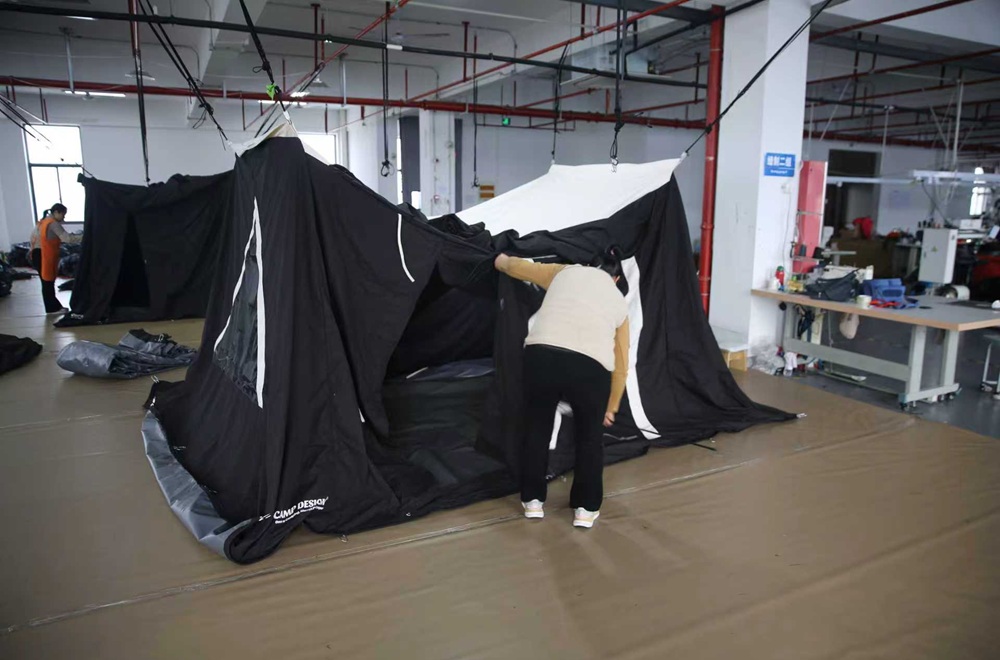
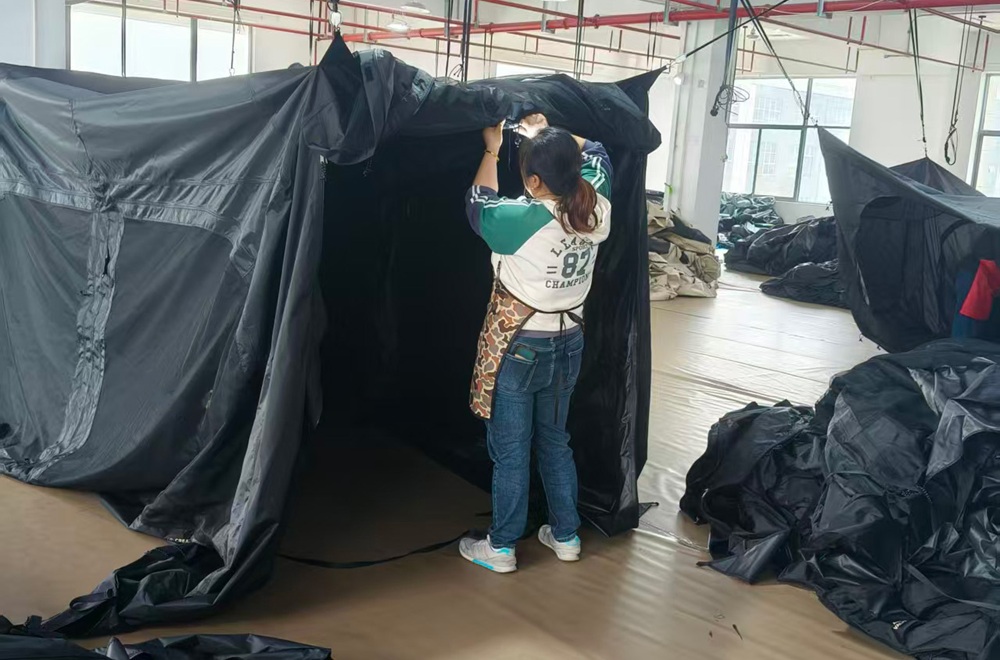
Production photos are useful when they show something the buyer actually needs to see: the product being made, an inspection taking place, the condition of a finished tent or a defect that was found. Their limitation is equally practical—a photograph only shows what was captured in that image.
NastoCamp customers sometimes request production photos or real-time video while their bulk orders are being manufactured.
Because many orders are customized, customers can often recognize their products from the tent’s color and appearance. If there is still uncertainty, the factory can show the relevant product in real time by video.
This can help the buyer recognize the relevant product, although the photo alone may not establish which order it belongs to.
If a Defect Is Found, What Evidence Shows What Happened Next?
Finding a defect is only one part of quality control.
At NastoCamp, when an inspector finds a nonconforming product, the problem may be photographed and marked. The affected product is then moved to the nonconforming-product area rather than continuing directly through the normal production flow.
Products requiring correction can then be collected for rework. After rework, the affected products are inspected again. Once they pass the relevant check, they can return to the normal production flow.
Defect photos may also be shared internally with production staff so that the problem is visible to the team and can be avoided during subsequent work.
A defect photo tells the buyer what was found, but not necessarily what happened afterward. If the question is whether the affected product was separated, reworked and checked again, evidence from those later steps becomes more relevant.
So when a quality problem appears in the evidence, a useful follow-up question is:
What happened to the affected products after the problem was found?
What Can a Buyer Verify Through a Live Video Call?
For an overseas buyer who cannot be at the factory, live video can answer some practical questions immediately.
At NastoCamp, a customer can ask to see the overall appearance of a tent, check dimensions, look at the inside and other specified details, review packing contents or see how far production has progressed. The buyer can also ask the person holding the camera to move to a particular product or area.
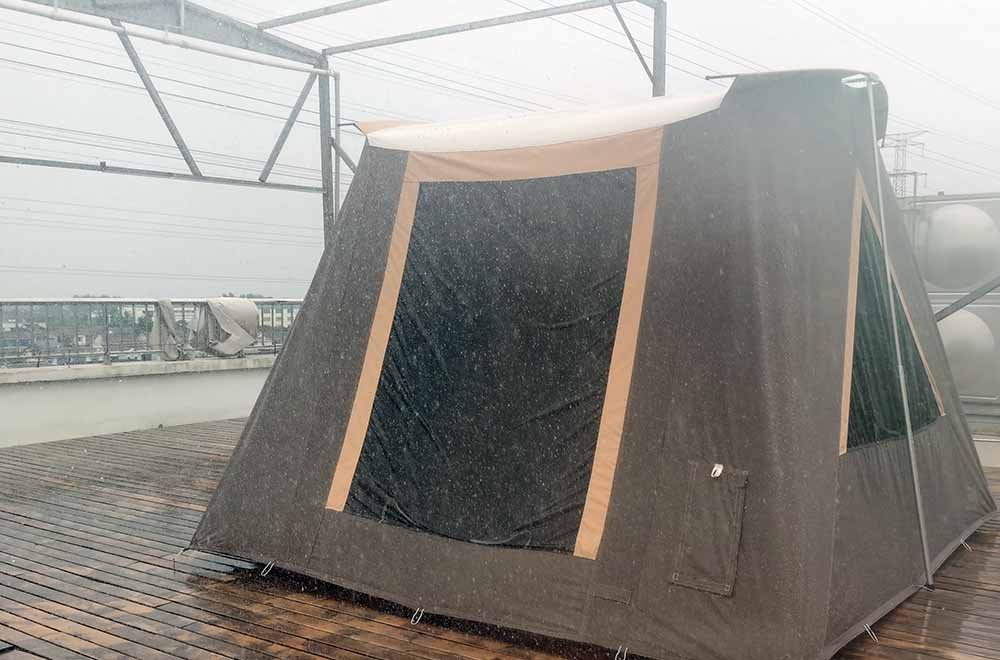
Some requirements cannot be reliably checked this way. Specific material properties or performance indicators may require other forms of verification. Waterproof-related performance, for example, cannot be established simply by looking at the tent through a video call; it requires testing appropriate to the specific material, construction or finished-tent question being evaluated.
For buyers who need to understand this distinction in more detail, rain testing can provide evidence about specific aspects of tent waterproof performance, but the result still needs to be interpreted according to what was actually tested.
Live video is also not a practical substitute for inspecting a broader quantity of products when sampling across the production lot is required.
Its value is therefore greatest when the question can reasonably be answered by seeing something in real time.
The Evidence Question Changes as the Order Moves Forward
As a project progresses, useful evidence usually becomes more specific to the buyer’s own product and production.
Before placing an order, the buyer may still be evaluating the factory itself: how it manages quality in practice and whether the products and production conditions being observed are broadly consistent with the level required for the project. This does not necessarily mean collecting as many QC documents as possible before proceeding. Depending on the project, relevant product examples, samples and direct observation may be more useful.
Before bulk production, the manufacturer may need to confirm that the pre-production or production reference matches the approved sample or other agreed product requirements, and that the materials prepared for production correspond to what was confirmed. From there, the control question becomes how bulk production remains consistent with the approved sample.
Once bulk production begins, production photos, video, inspection information and checks on semi-finished products can provide evidence closer to the actual order.
Before shipment, the buyer’s questions change again. Finished-product condition, inspection results, completed quantity and whether the required items are packed correctly become more relevant. Where sampling inspection is required, buyers may also need to understand what an AQL inspection result does—and does not—tell them.
No single document, photograph or video answers every quality-control question.
Instead of asking how large a manufacturer’s QC evidence package is, ask whether the evidence shown actually answers the question you are trying to verify—and what still remains unverified.